


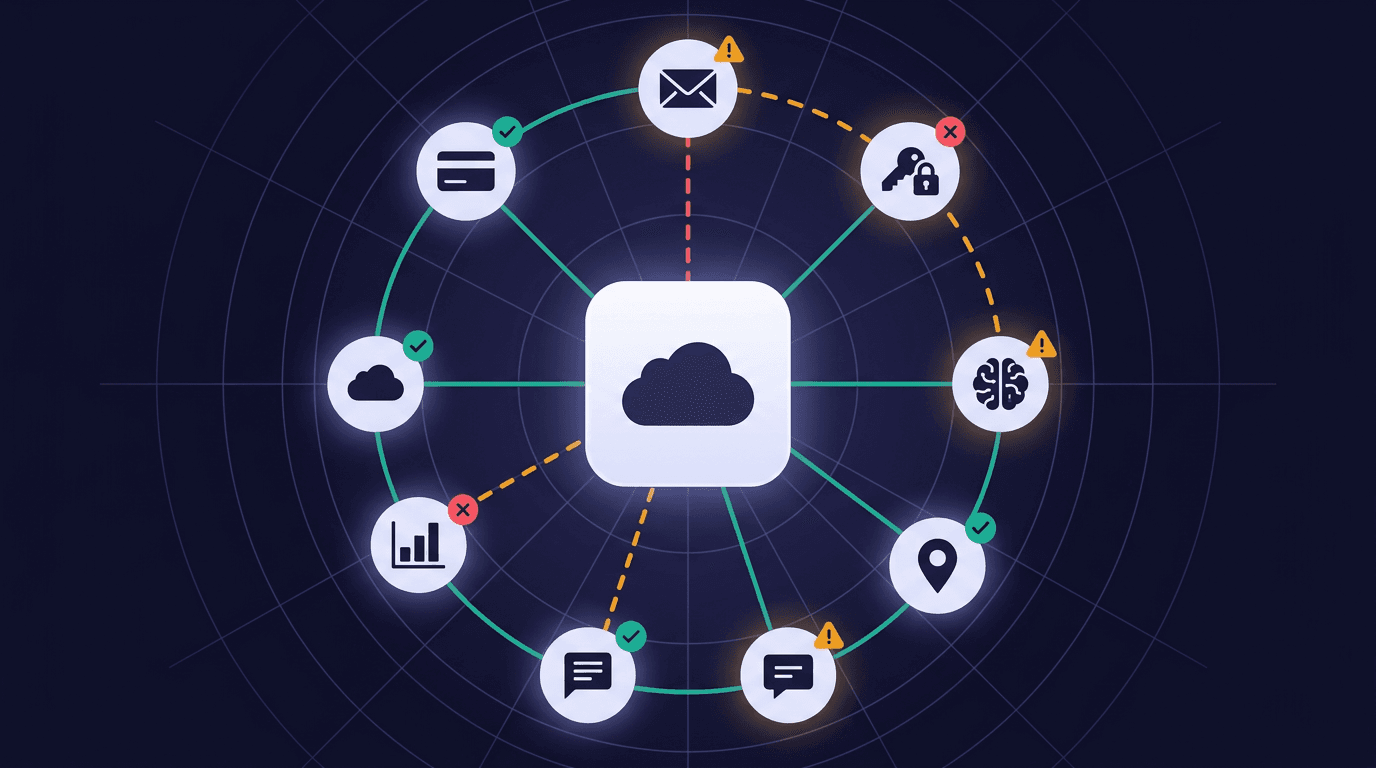
Third-party API monitoring is essential for modern SaaS products because most of the critical functionality your customers depend on is not running on your servers. Payments flow through Stripe or Braintree. Emails are sent through SendGrid or Resend. Authentication relies on Auth0 or Firebase. AI features call OpenAI or Anthropic. Search is powered by Algolia or Elasticsearch Cloud. File storage lives in AWS S3 or Cloudflare R2. Analytics run through Segment or Mixpanel. Push notifications go through Firebase Cloud Messaging or OneSignal.
When any of these services degrade or fail, your customers do not blame the vendor. They blame your product. From the user's perspective, a failed checkout is your checkout failing. A missing password reset email is your system being broken. A slow AI response is your feature being unusable. The vendor's reliability becomes your reliability, and without monitoring, you will not know about the failure until your customers tell you.
That is why third-party API monitoring is not a luxury or an advanced practice. For modern SaaS products that depend on external services for core functionality, it is a basic operational requirement.
How Dependent Modern SaaS Products Really Are
The extent of third-party dependency in a typical SaaS product is often larger than teams realize. A product that appears to be a single application is usually a composition layer sitting on top of dozens of external APIs.
Consider the typical user journey through a SaaS product. The user logs in through an identity provider. The session is validated against a token service. The dashboard loads data that may include payment status from a billing API, usage metrics from an analytics service, and content processed by an AI model. The user performs an action that triggers an email notification through a transactional email service and a webhook through an integration platform. Each step in that journey depends on at least one external API.
If any of those APIs is slow, returning errors, or completely unavailable, the user journey breaks. The breakage might be total, like a failed login. Or it might be partial, like a dashboard that loads but shows stale billing data. Or it might be silent, like a notification email that never arrives. Each type of failure has a different business impact, but all of them erode the trust your customers place in your product.
Why Vendor Status Pages Are Not Enough
Many teams rely on vendor status pages to track third-party health. This is understandable but insufficient. Vendor status pages have several structural limitations that make them unreliable as a primary monitoring signal.
First, status pages are updated by the vendor, which means they reflect the vendor's view of their own health. That view may not match what your product actually experiences. A vendor might report "all systems operational" while your specific API endpoint, region, or account tier is experiencing degraded performance. Status pages often track broad service categories rather than the specific endpoints your product calls.
Second, status page updates are delayed. Vendors need to confirm an issue internally before publishing it. By the time a status page changes from green to yellow, your customers may have been affected for 10, 20, or 30 minutes. For a SaaS product where checkout, authentication, or core workflows depend on that vendor, 30 minutes is a significant incident.
Third, status pages do not capture your network path. The performance you experience depends on the route between your infrastructure and the vendor's API. That path includes DNS resolution, network transit, load balancers, and geographic proximity. A vendor's API can be healthy globally while performing poorly from your specific cloud region or edge location.
For all of these reasons, direct monitoring from your own perspective is the only reliable way to know whether a third-party API is working well enough for your product.
What Happens When You Do Not Monitor Third-Party APIs
The consequences of unmonitored third-party dependencies follow a predictable pattern. The vendor experiences a degradation. Your product starts behaving differently. Customers notice before your team does. Support tickets arrive. Engineers begin investigating internal systems, finding nothing wrong. Eventually someone checks the vendor's status page or tests the external API manually. By then, the incident has been active for much longer than necessary.
This pattern is expensive in multiple ways. Customer trust degrades because the product appeared broken without explanation. Engineering time is wasted investigating internal systems that were healthy. Support teams absorb frustration without useful information to share. Leadership cannot communicate clearly because the root cause took too long to identify.
Without third-party monitoring, the mean time to detection for vendor-related incidents is driven by customer complaints instead of automated alerting. That is the slowest and most damaging detection method available.
Which Third-Party APIs to Monitor First
Not every external dependency carries the same risk. The APIs to monitor first are the ones whose failure directly affects the customer experience or blocks a critical business workflow.
Payment and Billing APIs
Payment processing is the most revenue-sensitive dependency. If the payments API is down, customers cannot upgrade, renew, or complete purchases. Even a brief degradation during checkout can cause abandoned transactions and lost revenue. Monitoring should verify that the payment API responds within acceptable latency, returns valid responses, and correctly processes test transactions when possible.
Authentication and Identity APIs
If the authentication provider fails, no user can log in. This is a total product outage from the customer's perspective, even though your application, database, and hosting are all healthy. Auth API monitoring should check login flows, token validation, and refresh operations with enough frequency to detect outages within minutes.
Transactional Email APIs
Password resets, account verifications, billing receipts, and critical notifications all depend on transactional email services. If the email API is slow, queuing messages, or failing silently, customers may never receive time-sensitive communications. Monitoring should verify API response status and latency. Ideally, it should also validate that delivery signals are consistent with expected behavior.
AI and Machine Learning APIs
SaaS products increasingly integrate AI capabilities through external APIs. These services have unique failure characteristics: they can become extremely slow under high demand, return degraded quality responses, hit rate limits, or fail with quota exhaustion errors. Monitoring should track both availability and response time, because a 30-second AI API response is functionally a timeout for most interactive features.
Search and Data APIs
External search services power product discovery, knowledge bases, and content recommendations. If search degrades, users cannot find what they need, which quietly reduces engagement and productivity. Monitoring should verify that search results return within acceptable latency and contain expected content structures.
Communication and Notification APIs
Push notifications, SMS delivery, in-app messaging, and webhook delivery often depend on external services. Failures in these systems are particularly dangerous because they are often silent. The message leaves your system successfully but never reaches the user. Monitoring the API layer catches at least the first point of failure.
Storage and CDN APIs
File uploads, image processing, and asset delivery often depend on cloud storage and CDN providers. If the storage API is slow or returning errors, users cannot upload content, and previously stored assets may fail to load. Monitoring should cover the specific storage operations your product uses most frequently.
How to Monitor Third-Party APIs Effectively
Monitoring third-party APIs requires a different approach than monitoring your own services. You do not control the code, the infrastructure, or the deployment schedule. Your monitoring must work from the outside, measuring the experience your product actually receives.
Monitor From Your Product's Perspective
The most useful third-party monitoring replicates the API calls your product makes. Use the same endpoints, the same authentication, the same request parameters, and the same regions your production traffic uses. This ensures that what your monitoring measures matches what your customers experience.
A generic health check against the vendor's root domain is not sufficient. If your product calls a specific API version, uses a specific authentication flow, and sends requests from a specific cloud region, your monitoring should replicate that exact path.
Track Response Time Separately From Your Own APIs
Third-party API response time should be tracked independently so that it can be distinguished from your own application's performance. When your product's overall response time increases, the first question is whether the slowdown is internal or caused by a dependency. If third-party latency is tracked separately, that question can be answered immediately.
This also helps with vendor accountability. If a payment API that historically responds in 200ms starts consistently responding in 800ms, you have data to discuss with the vendor. Without independent tracking, that degradation becomes invisible inside your own application's aggregate metrics.
Validate Response Content, Not Just Status
Third-party APIs can return 200 OK while delivering degraded results. An AI API might return a valid response structure but with a fallback or low-quality answer. A search API might return an empty result set instead of relevant matches. A payment API might accept a request but return a processing status that indicates queuing rather than completion.
Response validation for third-party APIs should check that the response structure matches expectations and that key fields contain meaningful values. This catches the subtle degradation modes where the API is technically available but not delivering the quality your product depends on.
Monitor Rate Limits and Quota Usage
Third-party APIs enforce rate limits and usage quotas. Approaching or hitting these limits can cause sudden failures even when the vendor's infrastructure is healthy. Monitoring should track rate limit headers in API responses and alert when usage approaches the threshold.
Quota exhaustion is a common cause of third-party incidents for growing SaaS products. Traffic increases, a marketing campaign drives higher API usage, or a background process consumes more calls than expected. Without monitoring, the first sign of quota exhaustion is a customer-facing failure.
Test From Multiple Regions
If your product serves global traffic, third-party API performance may vary by region. A payment API that responds in 100ms from US-East might take 500ms from Asia-Pacific. Monitoring from multiple regions reveals these geographic disparities and helps teams make infrastructure decisions about where to place latency-sensitive API calls.
Building Fallback Awareness Through Monitoring
Third-party monitoring is not just about detecting failures. It is also about providing the data needed to activate fallback strategies. Many SaaS products implement graceful degradation for external dependencies: cached results when search is slow, queued messages when email is down, alternative payment methods when the primary processor fails.
Monitoring makes these fallback decisions data-driven. When the monitoring system detects that a third-party API has crossed a latency threshold or is returning errors, it can trigger automated fallback activation or alert the team that manual intervention is needed. Without monitoring, fallback decisions are either hardcoded with static timeout values or made reactively after customers have already been affected.
The most effective fallback systems are connected to monitoring. They use the same signals that power alerts to make real-time decisions about routing traffic, activating caches, or switching to backup providers.
Managing Vendor Relationships With Monitoring Data
Third-party API monitoring produces data that is valuable beyond operational response. It creates an objective record of vendor performance over time.
When a vendor claims 99.99% uptime, your monitoring data can confirm or challenge that claim based on what your product actually experienced. When contract renewal discussions happen, latency trends, error rates, and incident counts provide concrete evidence for negotiation. When evaluating alternative vendors, your monitoring baseline for the current provider gives you a clear comparison target.
This data also helps with architectural decisions. If a dependency consistently operates near your latency budget, that is a signal to consider caching, regional deployment changes, or vendor alternatives. If a dependency has had multiple incidents in the past quarter, that risk should factor into product planning and redundancy investment.
How Third-Party Failures Compound in Microservice Architectures
SaaS products built on microservice architectures face an amplified version of the third-party risk problem. A single user request may traverse multiple internal services, each of which may call one or more external APIs. The probability of at least one dependency being degraded at any given time increases with every additional external call in the chain.
This creates compounding failure risk. Service A calls a payment API and an email API. Service B calls an AI API and a search API. Service C calls a storage API and a notification API. If any one of those six external calls fails, the user experience degrades. The more dependencies in the chain, the more important monitoring becomes because the likelihood of an unmonitored failure affecting customers grows with each dependency added.
Monitoring the full dependency tree, not just the first-level external calls, is what prevents these compounding failures from turning into extended customer-facing incidents.
Common Mistakes in Third-Party API Monitoring
Several recurring mistakes undermine third-party monitoring effectiveness.
The first is monitoring only the vendor's generic health endpoint instead of the specific endpoints your product uses. A vendor's health check can return 200 while the payment processing endpoint is failing. Monitor what you actually call.
The second is relying on the vendor's status page as your monitoring system. By the time a status page is updated, your customers have already been affected. Direct monitoring from your infrastructure is faster and more accurate.
The third is not tracking response time for third-party APIs separately. If external latency is bundled into your own application metrics, you cannot distinguish internal degradation from vendor degradation. Separate tracking enables faster root cause identification.
The fourth is ignoring rate limits and quotas. These are not vendor problems. They are your operational responsibility. Monitor usage against limits and alert before exhaustion, not after.
The fifth is treating all third-party dependencies as equal priority. Payment, authentication, and core workflow APIs deserve tighter monitoring than analytics or optional feature APIs. Priority should match business impact.
The sixth is not testing fallback behavior. If your product has graceful degradation for a dependency, monitor whether the fallback actually activates when the dependency fails. An untested fallback is a false safety net.
What to Look for in a Third-Party Monitoring Setup
An effective third-party API monitoring setup includes:
- synthetic checks against the specific endpoints your product calls
- realistic authentication and request parameters matching production usage
- multi-region monitoring from the same locations your traffic originates
- response time tracking at p50, p95, and p99 with per-dependency thresholds
- response body validation for content quality and structure
- rate limit and quota tracking with pre-exhaustion alerting
- separate dashboards or views for third-party health distinct from internal services
- alert routing to the team responsible for each dependency integration
- historical performance data for vendor accountability and contract discussions
- integration with your incident management workflow for fast escalation
When these components are in place, third-party failures become detected incidents with clear context instead of mysterious customer complaints that take 30 minutes to diagnose.
Final Thoughts
Third-party API monitoring is essential for modern SaaS products because the boundary between your product and your vendors is invisible to your customers. When a payment API fails, it is your checkout that is broken. When an email API is slow, it is your notifications that are missing. When an AI API returns degraded results, it is your feature that feels broken.
Your product's reliability is bounded by the reliability of every external service it depends on. Without monitoring, you cannot detect those failures faster than your customers can. With monitoring, you gain the visibility to detect vendor issues within minutes, activate fallback strategies based on real data, communicate transparently during incidents, and hold vendors accountable with objective performance history.
For any SaaS product where third-party APIs power authentication, payments, email, AI, search, storage, or communications, monitoring those dependencies is not an advanced optimization. It is a fundamental part of operating a reliable product. The teams that monitor their dependencies are the ones that respond fastest, protect customer trust most effectively, and make the most informed decisions about their vendor architecture.