


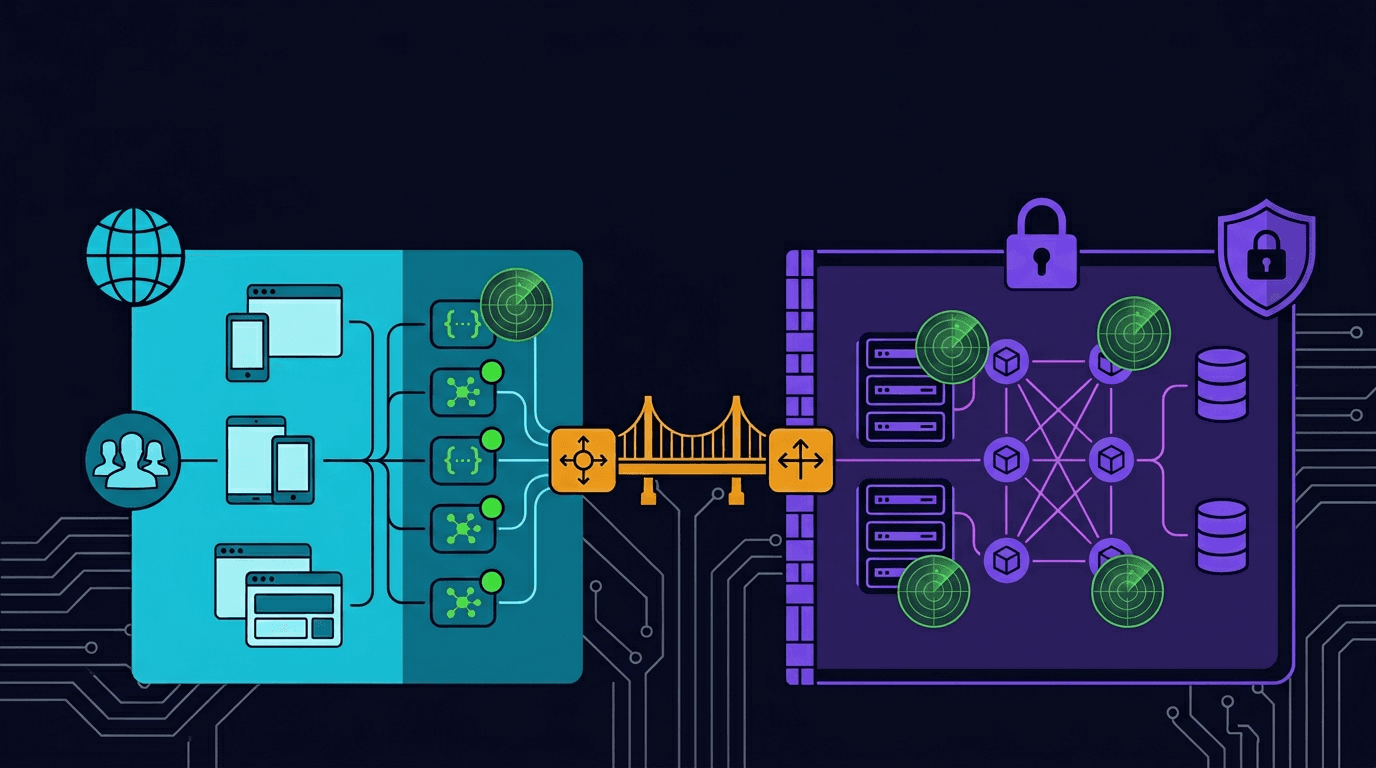
Building an API monitoring strategy for both public and private endpoints requires recognizing that these two categories of APIs have different consumers, different failure modes, different security constraints, and different monitoring access requirements. A public endpoint serves external users, partners, or customer applications over the open internet. A private endpoint serves internal microservices, background workers, admin tools, or infrastructure components behind a network boundary. Both can cause severe incidents when they fail, but the way you monitor each one must account for the differences.
Most teams start by monitoring their public-facing APIs because those are directly visible to customers. That is a reasonable starting point, but it creates a dangerous blind spot. Private endpoints often carry the load that public endpoints depend on. A failing internal authentication service, a slow database gateway, a broken inter-service communication path, or a degraded message queue API can take down the entire public surface even though the public endpoints themselves are technically reachable. A complete monitoring strategy covers both layers because reliability depends on the full chain, not just the visible edge.
Why Public and Private Endpoints Need Different Monitoring Approaches
The fundamental difference is who consumes the API and how they reach it.
Public endpoints are accessed by external clients over the internet through DNS resolution, CDN routing, load balancers, and TLS termination. They face unpredictable traffic patterns, abuse attempts, geographic diversity, and the full range of network conditions between the client and the server. Monitoring must account for all of these factors because any of them can affect the experience.
Private endpoints are accessed by internal services within a controlled network environment. They typically use service discovery, internal DNS, private networking, and often skip TLS or use mutual TLS for authentication. Traffic patterns are more predictable, but the failure modes are different: service mesh misconfigurations, container orchestration issues, internal DNS failures, and cascading timeout chains that propagate through the dependency graph.
A monitoring strategy that treats both types identically will either over-monitor private endpoints with unnecessary external checks or under-monitor them by relying on the same external probes that cannot reach internal networks. The right approach designs monitoring for each type based on its access model, risk profile, and operational importance.
Step 1: Map and Classify Your API Landscape
Before building monitoring, you need a clear inventory of what exists. Most growing organizations have far more API endpoints than they realize, spread across multiple services, environments, and network boundaries.
Classify by Exposure
Start by classifying every API endpoint into one of these categories:
- Public external: Accessible to anyone on the internet without authentication. Marketing pages, public documentation APIs, status endpoints.
- Public authenticated: Accessible over the internet but requiring authentication. Customer-facing product APIs, partner integrations, mobile app backends.
- Private internal: Accessible only within the internal network or VPC. Microservice-to-microservice communication, internal admin APIs, background job processors.
- Private infrastructure: Low-level infrastructure APIs that support the platform. Database proxies, cache layers, message queue interfaces, service mesh control planes.
Each category has different monitoring requirements, different acceptable latency thresholds, different authentication handling, and different ownership structures.
Classify by Business Impact
Within each exposure category, rank endpoints by business impact. A public authenticated API that processes payments is more critical than a public endpoint that serves marketing content. An internal API that handles authentication token validation is more critical than an internal API that generates weekly reports. Business impact determines monitoring frequency, alert severity, and SLO targets.
The combination of exposure classification and business impact creates a monitoring priority matrix that guides the entire strategy.
Step 2: Design Monitoring for Public Endpoints
Public endpoints should be monitored externally, from the perspective of the users who consume them. This means running synthetic checks from geographic locations that match your user base, over the public internet, through the same DNS, CDN, and load balancing path that real traffic follows.
External Synthetic Checks
For each critical public endpoint, configure synthetic HTTP checks that:
- resolve DNS and establish connections through the public path
- use realistic authentication (API keys, OAuth tokens, JWTs) matching what clients send
- validate status codes, response time, and response body content
- run from multiple geographic regions at 30-second to 2-minute intervals
- test with the same HTTP methods and request bodies that real clients use
This external perspective is essential because internal health checks cannot detect problems in the public delivery path. A DNS misconfiguration, a CDN cache error, a load balancer health check mismatch, or a TLS certificate issue will be invisible from inside the network but completely visible to external monitoring.
Monitor the Consumer Experience
Public API monitoring should measure what the consumer experiences, not what the server thinks it is delivering. That includes DNS resolution time, TLS handshake duration, time to first byte, and total response time. If any of these layers is slow, the consumer experience degrades even if the application processing is fast.
For APIs consumed by mobile clients, latency thresholds should account for the additional network variability that mobile connections introduce. For APIs consumed by partner integrations, monitoring should validate that rate limit headers, pagination, and error response formats meet the documented contract.
Track Rate Limits and Abuse Patterns
Public endpoints face traffic that internal endpoints do not: bot crawling, credential stuffing, scraping, and accidental client loops. Monitoring should track whether rate limiting is functioning correctly and whether unusual traffic patterns are affecting legitimate users. A rate limit that is too aggressive blocks real users. A rate limit that is too permissive allows abuse that degrades performance for everyone.
SLOs for Public Endpoints
Public endpoint SLOs should reflect the experience promise made to consumers. If the API documentation states a 99.9% availability target and sub-500ms response time, monitoring should measure and report against those specific commitments. For partner-facing APIs with contractual SLAs, monitoring data becomes the evidence for compliance reporting.
Public SLOs typically need tighter targets than private SLOs because external consumers have less tolerance for failures and less context for understanding them. An internal service can retry automatically. An external mobile app may show an error screen to the user immediately.
Step 3: Design Monitoring for Private Endpoints
Private endpoints require a different monitoring approach because they cannot be reached from external monitoring probes. The monitoring infrastructure must have access to the internal network where these services communicate.
Internal Monitoring Probes
The most common approach is running monitoring agents or synthetic check executors inside the private network. These probes send requests to internal endpoints using the same service discovery, internal DNS, and authentication mechanisms that production services use.
For Kubernetes environments, monitoring probes can run as pods within the cluster, accessing services through internal service names and cluster DNS. For VPC-based architectures, monitoring agents run within the VPC with appropriate security group access. For hybrid environments, probes may need to run in multiple network zones.
The probe should replicate how the endpoint is actually called in production. If services communicate through a service mesh with mutual TLS, the monitoring probe should use the same authentication path. If services resolve through internal DNS with short TTLs, the probe should resolve the same way. The closer the monitoring path matches the production path, the more accurately it represents real behavior.
Monitor Inter-Service Dependencies
Private endpoint monitoring should focus heavily on the dependency relationships between services. In a microservice architecture, a single user request may traverse 5 to 15 internal API calls. A failure or degradation at any point in that chain affects the final response.
Dependency-aware monitoring maps these relationships and tracks each internal API's performance and availability independently. When a public-facing incident occurs, this internal visibility helps teams quickly identify which internal service is the root cause instead of investigating the entire chain manually.
Track Internal Latency Budgets
Every public API response includes time spent in internal service calls. If the public SLO requires a 500ms response, and the request traverses three internal services, each service has an implicit latency budget. If one internal service consumes 400ms of the 500ms budget, the public SLO is already at risk even though no single internal check has failed.
Monitoring internal endpoints with latency thresholds derived from the public SLO budget ensures that internal degradation is detected before it breaks the external experience. This budget-based approach is more effective than monitoring each internal service in isolation because it connects internal performance to the outcome that actually matters.
Handle Authentication for Private Endpoint Monitoring
Internal APIs often use different authentication mechanisms than public APIs. Service-to-service communication may use mutual TLS, internal JWT tokens, service account credentials, API keys scoped to internal use, or no authentication at all if the network boundary is trusted.
Monitoring probes need credentials that match the internal authentication model. These credentials should be managed with the same security practices as production service credentials: rotated regularly, scoped to minimum required permissions, and stored in secret management systems. A monitoring probe with overly broad permissions or stale credentials creates both security risk and monitoring reliability risk.
SLOs for Private Endpoints
Private endpoint SLOs should be derived from their contribution to public-facing service levels. If an internal authentication service is called on every user request and the public API has a 99.9% availability SLO, the internal authentication service needs an availability target at least as tight, because its failures directly propagate to the public surface.
For internal services that are called by multiple public endpoints, the SLO should be based on the highest-criticality consumer. An internal data service that feeds both the checkout API and a weekly report generator should have its SLO aligned with checkout reliability, not report reliability.
Step 4: Build Unified Visibility Across Both Layers
The most valuable outcome of monitoring both public and private endpoints is the ability to correlate signals across both layers. When a public API incident occurs, the team should be able to see immediately whether the root cause is in the public delivery path or in an internal dependency.
Unified Dashboard Design
The monitoring dashboard should provide a layered view. The top layer shows public endpoint health: availability, latency, and error rates as experienced by external users. The second layer shows internal endpoint health: inter-service communication, database access, and infrastructure API status. The correlation between layers should be visible so that when a public endpoint degrades, the team can check whether any internal dependency is also degraded.
Color-coded status indicators, dependency arrows, or side-by-side comparison panels all help with rapid visual correlation. The goal is that an on-call engineer can look at one screen and understand whether the problem is external delivery, internal services, or a combination.
Correlated Alerting
Alert design should reflect the relationship between public and private endpoints. If a public API alert fires at the same time as an internal dependency alert, the alerting system should correlate these events instead of producing two separate alert threads. The responder needs to see one incident with both signals, not two unrelated alerts that they must mentally connect.
This correlation dramatically reduces response time because the responder immediately understands the full picture: the public checkout API is failing because the internal payment processing service is returning errors. Without correlation, the responder might spend 10 minutes investigating the public API before discovering the internal root cause.
Shared Incident Timeline
When incidents involve both layers, the incident timeline should include events from public and private monitoring. DNS change detected at 14:02. Internal database API latency spike at 14:03. Public checkout API errors begin at 14:04. This timeline helps teams understand causation and sequence, which is essential for both real-time response and post-incident review.
Step 5: Address Security and Compliance Considerations
Monitoring both public and private endpoints introduces security considerations that must be addressed in the strategy.
Protect Monitoring Credentials
Monitoring probes for both public and private endpoints use authentication credentials. These credentials must be stored securely, rotated on schedule, and scoped to the minimum permissions needed for monitoring. A compromised monitoring credential for a public API should not grant write access. A compromised credential for an internal probe should not expose production data.
Isolate Monitoring Traffic
In sensitive environments, monitoring traffic should be identifiable and separable from production traffic. This can be achieved through dedicated monitoring user agents, separate API keys, or network-level tagging. This separation ensures that monitoring activity does not interfere with production and that security teams can distinguish monitoring requests from potentially suspicious traffic.
Audit Monitoring Access
For organizations subject to compliance requirements, monitoring access to private endpoints should be documented and auditable. Which probes have access to which internal services, what credentials they use, and what data they can read should be part of the security and compliance posture. Monitoring is a form of automated access, and it should be governed accordingly.
Network Security for Internal Probes
Internal monitoring probes need network access to private endpoints, but that access should be constrained. Probes should only be able to reach the endpoints they are configured to monitor, not the entire internal network. Security group rules, network policies, or service mesh authorization should limit probe access to the minimum required scope.
Step 6: Establish Ownership and Review Cadence
A monitoring strategy that covers both public and private endpoints involves multiple teams. Public APIs may be owned by product engineering, platform teams, or developer experience teams. Private APIs may be owned by backend engineering, infrastructure teams, or individual microservice owners. The monitoring strategy must define who is responsible for each layer.
Assign Endpoint Ownership
Every monitored endpoint should have a designated owner who is responsible for maintaining the monitoring configuration, responding to alerts, and reviewing performance trends. For public endpoints, ownership often aligns with the product team that manages the consumer experience. For private endpoints, ownership aligns with the service team that maintains the code and infrastructure.
Run Cross-Layer Reviews
A quarterly review should bring together public and private endpoint owners to examine monitoring coverage, alert quality, SLO compliance, and gaps. This cross-layer review ensures that the monitoring strategy evolves as the architecture changes. New services, deprecated endpoints, changed dependencies, and shifted traffic patterns all require monitoring updates.
Maintain a Living Monitoring Inventory
The endpoint inventory created in Step 1 should be a living document that is updated whenever services are added, changed, or retired. Stale monitoring that checks deprecated endpoints creates noise. Missing monitoring on new endpoints creates blind spots. A regular reconciliation between the service catalog and the monitoring configuration prevents both problems.
Common Mistakes in Dual-Layer API Monitoring
Several mistakes recur when teams build monitoring strategies that span public and private endpoints.
The first is monitoring only public endpoints and assuming internal health is implied. Internal services can degrade in ways that are not immediately visible in public metrics until the degradation crosses a threshold and causes a sudden public-facing failure.
The second is using external monitoring probes for internal endpoints. External probes cannot reach private networks, and attempting to expose internal endpoints to external monitoring creates security risk without operational benefit.
The third is applying the same thresholds to both layers. Public and private endpoints have different performance characteristics and different acceptable latency ranges. A 50ms internal service call and a 300ms public API response should have different monitoring thresholds even if they are part of the same request chain.
The fourth is neglecting credential management for monitoring probes. Expired monitoring credentials cause false outage alerts that erode trust in the monitoring system. Credential lifecycle management for monitoring should be automated and reviewed regularly.
The fifth is building separate, disconnected monitoring systems for each layer. If public and private monitoring live in different tools with no correlation, the team loses the most valuable benefit: the ability to trace incidents across layers and identify root causes quickly.
Final Thoughts
Building an API monitoring strategy for public and private endpoints requires understanding that these two categories serve different consumers, face different risks, and require different monitoring access methods, but their reliability is deeply interconnected.
Public endpoints should be monitored externally from the consumer's perspective with geographic diversity, realistic authentication, response validation, and SLOs that match external expectations. Private endpoints should be monitored internally with probes that replicate production communication patterns, latency budgets derived from public SLOs, and dependency-aware visibility that connects internal health to external outcomes.
The strategy becomes most powerful when both layers are unified through correlated dashboards, connected alerting, and shared incident timelines. That unified visibility is what allows teams to detect incidents faster, identify root causes across layers, and respond with full context instead of partial information.
If your product depends on APIs, and most modern products do, then monitoring only the public surface is monitoring only half the system. The teams that build monitoring strategies covering both public and private endpoints are the ones that prevent the most incidents, resolve them the fastest, and maintain the strongest end-to-end reliability.