


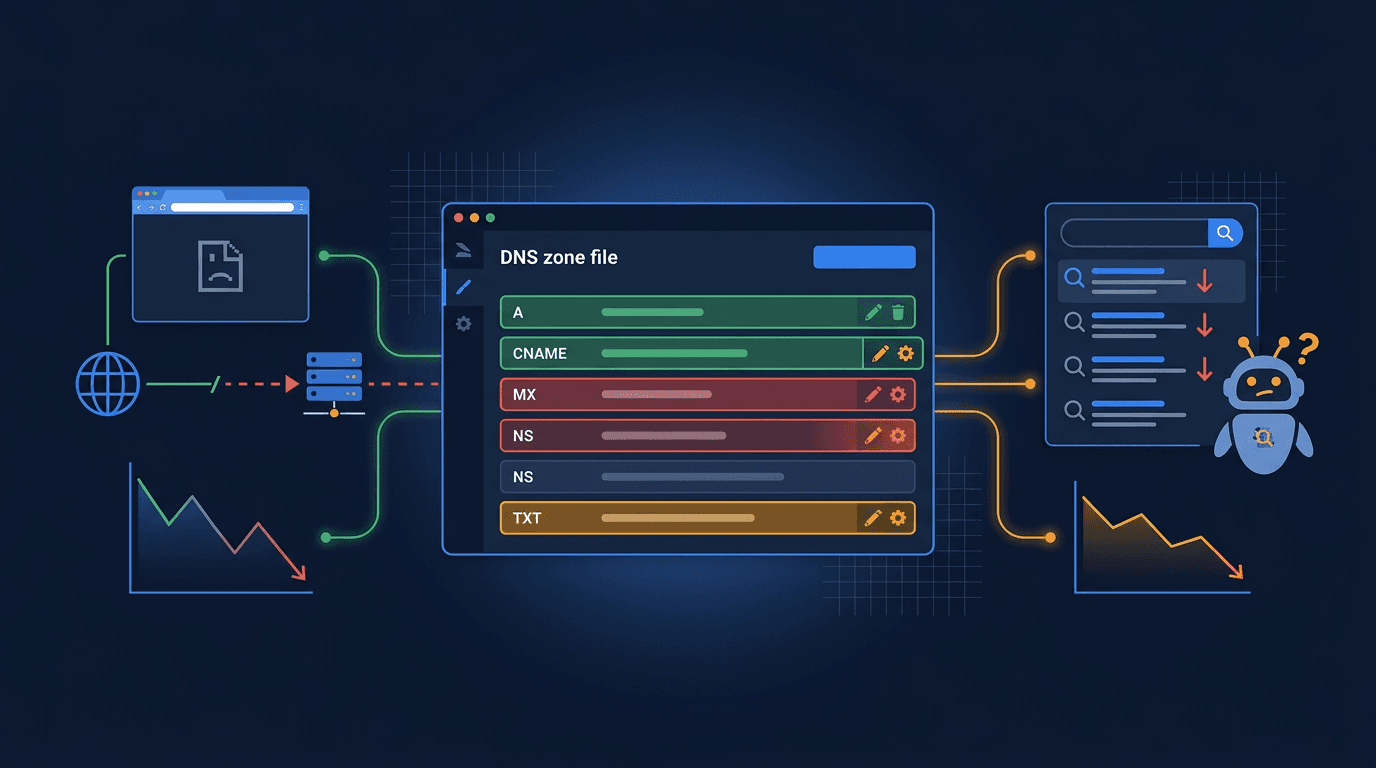
DNS changes are among the most powerful and most underestimated causes of website availability failures and SEO disruption. A single record modification can reroute all traffic to the wrong server, break email delivery, invalidate SSL certificates, and make an entire domain invisible to search engine crawlers. The change itself may take seconds. The consequences can last days or weeks.
The reason DNS changes carry so much risk is that DNS sits between every user, bot, and system that wants to reach your domain. It does not matter how healthy your servers are or how optimized your content is. If DNS resolves incorrectly, nothing downstream works. And because DNS changes propagate through a distributed caching system, mistakes are not always immediately visible everywhere at once, which makes them harder to diagnose and slower to recover from.
Why DNS Changes Are Different From Other Infrastructure Changes
Most infrastructure changes affect one layer at a time. A server configuration change affects that server. A code deployment affects the application. A CDN update affects edge delivery. But DNS changes operate at the resolution layer, which means they can affect everything simultaneously.
When an A record changes, the website may point to a different IP address. When nameservers change, the entire zone can shift to a different provider. When a CNAME is modified, a subdomain may resolve to a completely different destination. When MX records change, email delivery reroutes. Each of these changes alone can cause a significant incident. Combined or mistimed, they can create cascading failures across website, email, APIs, and third-party integrations.
That scope is what makes DNS changes uniquely dangerous. They are fast to execute, slow to propagate, and broad in their blast radius.
How DNS Changes Cause Website Availability Failures
Website availability depends on DNS resolving correctly to an IP address that serves healthy content. Any DNS change that disrupts that chain creates downtime, whether the change was intentional or accidental.
A Record Misconfigurations
The A record maps a domain to an IPv4 address. If this record is changed to the wrong IP, traffic routes to a server that may not exist, may not be configured for the domain, or may serve entirely different content. The result is an immediate availability failure for anyone whose resolver picks up the new record.
This happens during migrations when old IPs are entered by mistake, during provider changes when records are updated in the wrong order, or when someone edits DNS manually and makes a typo. The website may look fine from locations still using cached DNS, while new visitors and crawlers see a broken site.
AAAA Record Problems
AAAA records serve the same function for IPv6. If an AAAA record points to an incorrect or unreachable IPv6 address, clients that prefer IPv6 resolution may fail to connect even while IPv4 still works. This creates partial outages that are difficult to reproduce and diagnose because the failure depends on the client's network stack and resolver behavior.
CNAME Breaks
CNAME records are widely used for subdomains, CDN routing, SaaS integrations, and marketing landing pages. If a CNAME target changes or is deleted, every subdomain pointing to that CNAME loses its resolution path. A common scenario is removing a CNAME that pointed to a CDN or hosting provider without first creating a replacement record. The subdomain simply stops resolving.
For organizations that use subdomain-heavy architectures for documentation, blogs, support portals, or regional sites, a single CNAME change can take down an entire product surface that looked independent from the main website.
Nameserver Changes
Nameserver changes are the highest-risk DNS modification because they transfer authority over the entire zone. If nameservers are pointed to a new provider that does not have the correct zone file, every record under the domain may return incorrect answers or fail entirely. Website, email, APIs, and subdomains can all break at once.
Nameserver changes also take longer to propagate because parent zone delegation updates are involved. That means the failure may be intermittent during propagation, working for some users and failing for others, which makes it especially confusing during troubleshooting.
TTL Miscalculations
Time-to-live values control how long resolvers cache DNS answers. If TTL is set too high before a planned change, the old record persists in caches long after the new record is live. If TTL is set too low permanently, every request triggers a fresh lookup, increasing latency and fragility.
The most dangerous TTL mistake happens during migrations. Teams change a record but forget that the previous TTL was 86400 seconds (24 hours). That means some resolvers will keep serving the old IP for up to a full day after the change, creating a long window of split traffic where some users reach the new server and others reach the old one or nothing at all.
How DNS Changes Disrupt SEO Performance
SEO depends on search engines being able to crawl, render, index, and serve pages reliably. DNS changes can disrupt every stage of that pipeline, often without any visible error in the application itself.
Crawl Disruption
Search engine crawlers resolve domains just like any other client. If DNS changes cause resolution failures, crawlers receive connection errors or timeouts instead of page content. A single failed crawl attempt may not cause ranking damage. But if the DNS issue persists through multiple crawl cycles, Google may reduce crawl frequency, delay indexing of new content, or temporarily drop affected pages from search results.
The risk is higher for large sites where crawl budget matters. If a significant portion of crawl requests fail due to DNS issues, the crawler spends its budget on errors instead of discovering and refreshing real content.
Indexing Delays and Deindexing
When crawlers cannot access pages due to DNS resolution failures, those pages cannot be indexed or re-indexed. If the failure lasts long enough, Google may treat the pages as unavailable and remove them from the index until reliable access is restored.
This is particularly damaging during site migrations. If DNS is changed as part of a migration and the new destination returns errors, pages that were previously well-indexed may lose their position. Recovering indexation after a DNS-related deindexing event can take days to weeks, depending on how long the failure lasted and how many pages were affected.
Redirect Chain Failures
Many SEO strategies rely on DNS-level or server-level redirects. Old domains redirect to new domains. HTTP redirects to HTTPS. Non-www redirects to www. Country domains redirect to regional paths. If a DNS change breaks any link in a redirect chain, the chain fails and the final destination becomes unreachable.
Search engines follow redirect chains to consolidate ranking signals. A broken chain means those signals stop flowing. The destination page may lose ranking equity that was being passed through the redirect, and the old URL may start returning errors instead of forwarding users and bots.
Certificate Mismatches After DNS Changes
SSL certificates are issued for specific domain names. If a DNS change points a domain to a server that does not have a valid certificate for that hostname, browsers will display a trust warning and most users will leave immediately. Search engines also treat certificate errors as a negative signal.
This is common when DNS changes happen without coordinating certificate deployment. The new server may have a valid certificate for a different domain, or it may have no certificate at all. The result is a site that resolves correctly at the DNS level but fails at the TLS level, creating a different kind of availability and trust failure.
Canonical and Hostname Confusion
DNS changes can also create situations where the same content is accessible on multiple hostnames or where the intended canonical URL stops resolving. If both www.example.com and example.com resolve but point to different servers with different configurations, search engines may become confused about which version is canonical. That can cause duplicate content issues, split ranking signals, and unpredictable index behavior.
Loss of Regional or Geo-Targeted SEO Value
For organizations using country-code domains or geo-specific subdomains, DNS changes that break resolution for specific regions can destroy localized SEO value. If de.example.com stops resolving because of a CNAME change, German search visibility is affected even though the main site is healthy. These partial failures are easy to miss without multi-region DNS monitoring.
When DNS Changes Are Most Dangerous for Availability and SEO
Not all DNS changes carry the same risk. The danger depends on timing, scope, and preparation.
During Site Migrations
Site migrations are the highest-risk window for DNS-related SEO damage. Teams are changing hosting, CDN, or DNS providers while trying to preserve URL structures, redirect chains, and certificate coverage. Any mistake in the DNS transition can create a gap where pages are unreachable, redirects break, or certificates do not match.
During Provider or Registrar Changes
Changing DNS providers or registrars involves updating nameservers, which transfers zone authority. If the new provider does not have the zone fully configured before the switch, there is a window where DNS queries return incomplete or incorrect answers.
During Unplanned Edits
Many DNS incidents are caused by manual changes that were not reviewed. Someone updates a record to test something, forgets to revert it, or changes the wrong record. Because DNS changes are fast and often irreversible in practice (due to caching), even brief mistakes can have lasting effects.
During High-Traffic and Campaign Periods
A DNS failure during a product launch, marketing campaign, or seasonal traffic peak has an outsized impact. More users are affected, more crawl activity may be happening, and the business cost per minute of downtime is higher. DNS changes should be avoided entirely during critical traffic windows unless absolutely necessary.
How to Reduce the Risk of DNS Changes
DNS changes cannot be avoided entirely. Domains migrate, infrastructure evolves, and records need updating. But the risk can be managed with discipline and monitoring.
Lower TTL Before Planned Changes
Before making any significant DNS change, reduce the TTL on the affected records well in advance. A common practice is to lower TTL to 300 seconds (5 minutes) at least 24 to 48 hours before the planned change. This ensures that when the new record goes live, resolvers pick it up quickly instead of serving stale cached answers for hours.
Validate the Destination Before Switching DNS
Before changing an A record, CNAME, or nameserver, verify that the destination is fully configured. The new server should be serving the correct content, the SSL certificate should be valid for the hostname, and redirects should be working. Changing DNS to point at an unprepared destination is one of the most common causes of migration-related outages.
Monitor DNS From Multiple Regions
DNS propagation is not instant or uniform. Monitoring from a single location may show the change as successful while other regions still see the old answer or experience failures. Multi-region DNS monitoring confirms that the change has propagated correctly and that no region is stuck in a broken state.
Track DNS Changes Continuously
Unexpected DNS changes are a leading cause of silent availability and SEO failures. Continuous DNS monitoring compares the current state of records against a known baseline and alerts when something changes. This catches accidental edits, unauthorized modifications, and drift that would otherwise go unnoticed until users or crawlers report problems.
Coordinate DNS Changes With Certificate and Redirect Workflows
DNS changes should never happen in isolation. If the domain is moving to a new IP, the certificate at that IP must already cover the domain. If a CNAME is being removed, the replacement record must already be in place. If nameservers are changing, the new zone must already contain every record the old zone had. Coordination prevents the gaps that cause availability failures and SEO disruption.
Audit DNS After Every Change
After making a DNS change, verify the result from multiple perspectives. Check that the record resolves as expected, that the website loads correctly, that SSL is valid, that email routing still works, and that redirects are intact. A post-change audit catches problems in the first minutes instead of hours or days later.
What Teams Should Monitor After a DNS Change
The first 24 to 48 hours after a significant DNS change are the most critical monitoring window. During this period, teams should watch for:
- resolution failures from any monitored region
- SSL certificate warnings or mismatches
- increased error rates on the website or API
- email delivery failures or bounce increases
- crawl error spikes in Google Search Console
- unexpected traffic drops in analytics
- redirect chain failures on migrated URLs
If any of these signals appear, the DNS change is the first place to investigate. Because DNS affects everything simultaneously, it is often the root cause behind symptoms that initially look like application, hosting, or CDN problems.
Final Thoughts
DNS changes impact website availability and SEO because DNS is the resolution layer that connects every user, crawler, and system to your domain. A correct DNS change, well-planned and carefully monitored, is a routine infrastructure operation. An incorrect or unmonitored DNS change can take down websites, break email, invalidate certificates, disrupt crawling, and damage search rankings in ways that take days or weeks to recover from.
The difference between a safe DNS change and a damaging one is almost always preparation, coordination, and monitoring. Teams that lower TTLs in advance, validate destinations before switching, monitor propagation across regions, and track DNS changes continuously are the ones that avoid the most preventable availability and SEO failures.
If your domain drives traffic, revenue, or customer trust, then every DNS change is an operational event that deserves the same care as a production deployment. Because at the DNS layer, that is exactly what it is.