


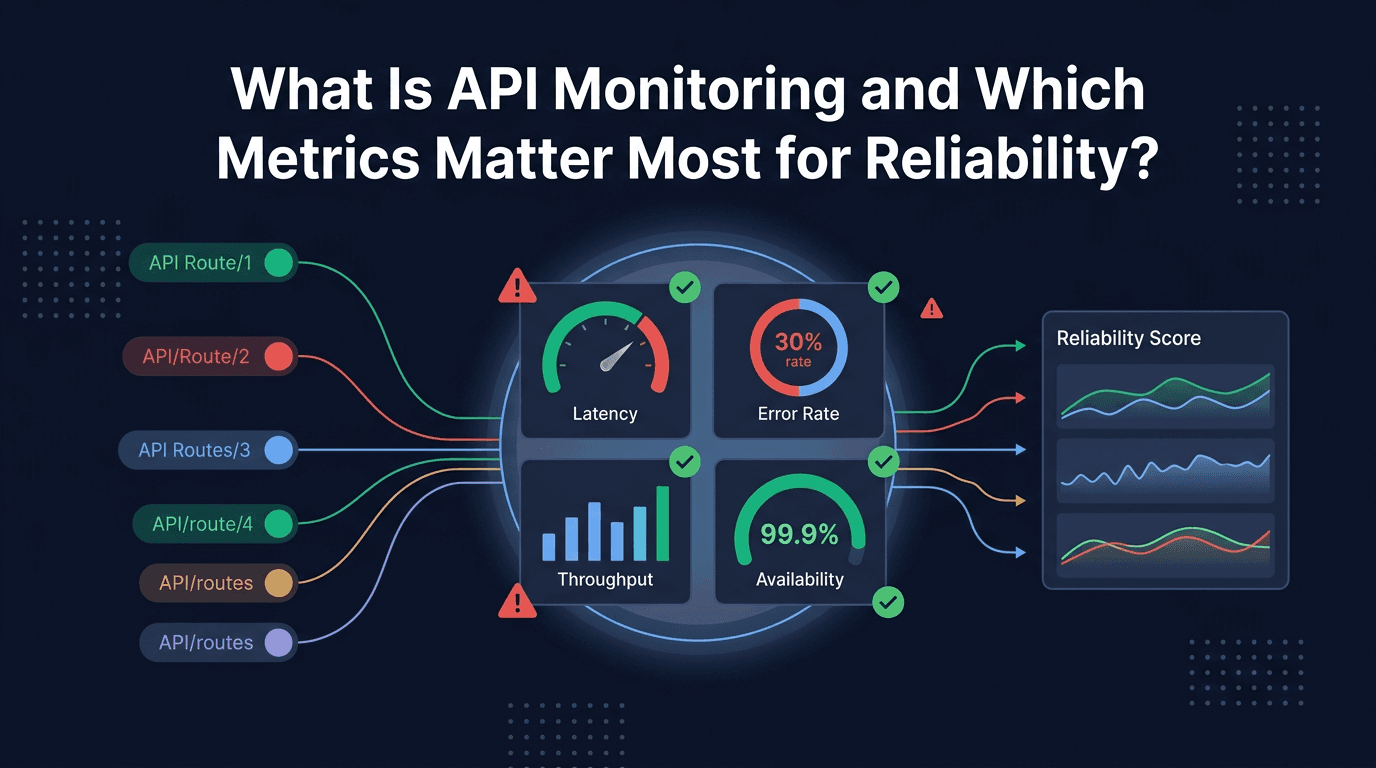
API monitoring is the practice of continuously testing API endpoints in production to verify that they are reachable, responsive, functionally correct, and performing within acceptable thresholds. It is the reliability layer that sits between the code your team deploys and the experience your users actually receive. When an API degrades or fails, the consequences spread quickly because APIs connect frontends to backends, microservices to each other, and products to third-party systems. Monitoring makes those failures visible before they cascade into customer-facing incidents.
But monitoring alone is not enough. What you measure determines whether your monitoring actually predicts and prevents reliability problems or just generates noise. The metrics you choose shape how your team detects degradation, prioritizes response, and defines what "healthy" means for each service. Tracking the wrong metrics creates false confidence. Tracking the right ones gives your team the ability to catch problems early, respond with context, and protect the services that matter most.
This guide explains what API monitoring is, how it works in practice, and which specific metrics matter most for teams that care about reliability.
What API Monitoring Actually Does
API monitoring works by sending synthetic requests to your endpoints on a regular schedule and evaluating the results. Each check typically measures whether the endpoint responded, how long it took, what status code it returned, and whether the response body matched expected criteria. More advanced monitoring also validates response schemas, tests multi-step workflows, checks authentication paths, and runs from multiple geographic locations.
The goal is to detect three categories of problems:
- Availability failures: The endpoint is unreachable, timing out, or returning server errors.
- Performance degradation: The endpoint responds, but too slowly for acceptable user experience.
- Correctness failures: The endpoint responds quickly with a success code, but the data is wrong, incomplete, or structurally broken.
Each of these categories has different reliability implications, and each requires different metrics to detect effectively. A monitoring system that only checks availability will miss the performance and correctness failures that often cause the most confusing and damaging incidents.
Why Metrics Selection Matters for Reliability
Reliability is not a single number. It is the intersection of availability, speed, correctness, and consistency over time. An API can be available but slow. It can be fast but returning incorrect data. It can be correct most of the time but unpredictable under load. Each of these failure modes affects users differently, and each requires a different metric to detect.
Teams that rely on a single metric, such as uptime percentage or average response time, often discover problems too late. The API looked healthy in the dashboard, but customers were already experiencing failures. That gap between metric visibility and actual user experience is where reliability risk lives. Choosing the right combination of metrics closes that gap.
Metric 1: Availability Rate
Availability is the most fundamental API reliability metric. It measures the percentage of monitoring checks where the endpoint was reachable and returned a non-error response. If the API is not available, nothing else matters.
Availability is typically expressed as a percentage over a time window: 99.9% availability over 30 days means the API was confirmed working in 99.9% of check intervals. The remaining 0.1% represents the failure budget, which corresponds to roughly 43 minutes of allowed downtime per month.
What makes availability nuanced is the definition of "available." A simple check might consider any HTTP response as available. A more meaningful check requires a success-class status code, a response within a timeout threshold, and valid content in the body. Teams should define availability in terms of what a successful response actually looks like for each endpoint, not just whether a TCP connection was established.
Availability is the metric that triggers the most urgent alerts. When availability drops, the incident is usually already customer-facing. But availability alone cannot tell you whether the API is fast enough, correct enough, or consistent enough to be truly reliable.
Metric 2: Response Time at P50, P95, and P99
Response time measures how long the API takes to return a complete response after a request is sent. It is the metric that most directly reflects user-perceived speed. But how you measure response time determines whether the metric is useful or misleading.
Why Averages Are Not Enough
Average response time is the most commonly tracked latency metric and the least useful for reliability. An API can have a healthy average while a significant portion of requests take far longer. If p50 is 120ms but p99 is 4 seconds, 1 in 100 users is waiting more than 30 times longer than the median. That experience is invisible in the average.
P50: The Typical Experience
The 50th percentile represents the median response time. Half of all requests are faster, half are slower. P50 is useful as a baseline indicator of normal performance. When p50 shifts upward, something fundamental has changed: a new code path, a heavier query, a database that is under strain, or a dependency that has slowed down.
P95: The Degradation Signal
The 95th percentile captures the experience of the slowest 5% of requests. This is where performance degradation usually becomes visible first. A rising p95 often indicates resource contention, garbage collection pressure, connection pool saturation, or intermittent dependency slowdowns that do not yet affect the majority of requests but are already affecting real users.
P95 is the metric that most reliably predicts whether an API is heading toward a performance incident. Teams that watch p95 closely catch problems earlier than teams that wait for the average to move.
P99: The Tail Risk Indicator
The 99th percentile captures the slowest 1% of requests. P99 is where the most extreme latency lives. High p99 values often point to timeout cascades, retry storms, cold starts, cache misses, serialization bottlenecks, or infrastructure-level issues like noisy neighbors in shared environments.
P99 is especially important for APIs that serve real-time interactions: search, payments, live dashboards, and authentication flows. In these cases, even 1% of users experiencing multi-second delays can generate support tickets, abandoned sessions, and lost revenue.
For reliability, the combination of p50, p95, and p99 provides a layered view of performance health. P50 shows the baseline. P95 shows emerging degradation. P99 shows tail risk. Together, they give teams the ability to detect and respond to performance problems at each stage of severity.
Metric 3: Error Rate
Error rate measures the percentage of API responses that return failure conditions. This includes HTTP 5xx server errors, 4xx client errors that indicate unexpected behavior, timeout errors, and application-level error responses that arrive with a 200 status code but contain error payloads.
Error rate is one of the most direct indicators of API health. A sudden spike in error rate almost always means something has broken: a deployment introduced a bug, a dependency failed, a database connection pool exhausted, or a configuration change took effect incorrectly.
Distinguishing Error Types
Not all errors carry the same reliability weight. Server errors (5xx) indicate problems the API cannot handle and the client cannot fix. These are high-severity signals. Client errors (4xx) may indicate invalid requests, which are sometimes expected. But a sudden increase in 4xx errors can also indicate a breaking API change, a misconfigured client, or a contract violation that deserves investigation.
Timeout errors deserve special attention because they represent the worst user experience: the client waited, received nothing, and has no information about what happened. High timeout rates often correlate with downstream dependency failures or infrastructure saturation.
Silent Errors
Some APIs return 200 OK with an error message in the response body. These "silent errors" are invisible to status-code-only monitoring. Detecting them requires response body validation, which checks for error keywords, empty result sets, missing required fields, or unexpected values. Silent errors are among the most dangerous API reliability problems because they evade basic monitoring completely.
Metric 4: Time to First Byte
Time to first byte (TTFB) measures the elapsed time between sending a request and receiving the first byte of the response. It isolates the server-side processing time and network transit from the full response download. TTFB is a more granular metric than total response time because it separates two distinct phases of the request lifecycle.
A healthy total response time with a high TTFB may indicate that the server is spending too long processing before it starts sending data. This can point to slow database queries, blocking operations, or resource lock contention. Conversely, a low TTFB with a high total response time suggests the server responds quickly but the payload is large or the network path is slow.
TTFB is particularly valuable for diagnosing performance problems because it helps teams locate whether the bottleneck is in server processing, payload size, or network delivery. For reliability, consistently rising TTFB on a previously stable endpoint is an early warning that the backend is under increasing strain.
Metric 5: Throughput
Throughput measures the number of requests an API handles per unit of time, typically expressed as requests per second or requests per minute. It is a capacity and demand metric rather than a quality metric, but it plays a critical role in reliability context.
Sudden throughput changes often precede or accompany reliability incidents. A traffic spike that exceeds the API's capacity can cause latency increases, error rate spikes, and eventual availability failures. A sudden throughput drop may indicate that upstream systems have stopped calling the API, which could mean a client failure, a routing change, or a DNS issue.
Monitoring throughput alongside latency and error rate helps teams understand whether performance changes are caused by load changes or by internal degradation. An API that slows down under the same throughput it handled last week has an internal problem. An API that slows down because throughput doubled has a capacity problem. The response to each is different, and throughput is the metric that distinguishes them.
Metric 6: Timeout Rate
Timeout rate is the percentage of requests that fail because the API did not respond within the configured timeout window. It deserves separate tracking from general error rate because timeouts represent a distinct and particularly damaging failure mode.
When a request times out, the client has consumed time and resources waiting for a response that never arrived. In microservice architectures, timeouts can cascade: service A waits for service B, which waits for service C. If C times out, B may also time out, and A may retry, amplifying load on an already struggling system.
A rising timeout rate is one of the strongest predictors of an imminent cascading failure. Teams that track timeout rate separately can detect these cascades before they become full outages. The metric also helps calibrate timeout thresholds: if a significant portion of requests consistently approach the timeout boundary, the threshold may be too tight or the endpoint may need optimization.
Metric 7: Response Validation Success Rate
Response validation success rate measures the percentage of API responses that pass content-level assertions beyond the HTTP status code. This includes schema validation, required field checks, data type verification, value range constraints, and business logic assertions.
This metric matters for reliability because an API that returns fast, 200-status responses with incorrect data is functionally broken even though availability and latency metrics look healthy. Validation success rate is the metric that catches these silent correctness failures.
For example, a pricing API that returns zero for every product price will pass availability and latency checks but cause real business damage. A user profile API that returns empty arrays instead of populated data will look healthy at the network level but create a broken application experience. Validation success rate catches these problems by measuring whether the API's contract is being honored, not just whether it responds.
Teams should define validation rules for their most critical endpoints and track the success rate as a first-class reliability metric alongside availability and latency.
Metric 8: DNS Resolution and Connection Time
Before an API can respond, several network-level operations must complete: DNS resolution, TCP connection establishment, and TLS handshake. These are usually fast, but when they degrade, every request to that endpoint is affected simultaneously.
DNS resolution time measures how long it takes to resolve the API's hostname to an IP address. A spike in DNS resolution time can indicate DNS provider issues, misconfigured records, or TTL-related caching problems. Connection time measures the TCP handshake duration, which can reveal network path degradation, firewall issues, or server-side connection acceptance problems.
These metrics are especially valuable for APIs served through CDNs, load balancers, or multi-region architectures where the network path between the client and the origin may change. A latency increase that originates in DNS or connection setup is a different problem from one that originates in application processing, and the fix is correspondingly different.
Metric 9: Geographic Performance Variance
Geographic variance measures how API performance differs across monitoring locations. An API may deliver 100ms responses from a nearby region but 800ms from a distant one. If both regions serve production traffic, the distant region's experience is the one that determines real reliability for those users.
Tracking performance by region helps teams detect CDN misconfigurations, routing asymmetries, regional infrastructure problems, and propagation delays that affect specific markets. It also helps validate that global load balancing, edge caching, and regional failover are working as intended.
For organizations with international users, geographic variance is a reliability metric because poor performance in a major market is functionally equivalent to partial unavailability. Users in that region experience degraded service even though global averages look healthy.
How These Metrics Work Together
No single metric provides a complete picture of API reliability. The value is in the combination and in understanding what each metric reveals that others do not.
Availability tells you whether the API is up. Latency percentiles tell you whether it is fast enough for real users. Error rate tells you whether it is failing. TTFB tells you where the bottleneck is. Throughput tells you whether demand has changed. Timeout rate warns you about cascading failures. Validation success rate tells you whether the data is correct. DNS and connection time tell you whether the network is healthy. Geographic variance tells you whether reliability is consistent across markets.
When these metrics are tracked together and correlated, teams can diagnose problems faster, prioritize response based on actual user impact, and build service level objectives that reflect the full definition of reliable service.
Common Mistakes in API Metric Selection
The most common mistake is tracking only availability and average response time. That combination misses tail latency, silent errors, correctness failures, and capacity-related degradation.
The second mistake is treating all endpoints equally. Business-critical APIs that serve authentication, payments, or core user journeys should have tighter thresholds and more granular metrics than low-traffic internal endpoints.
The third mistake is not correlating metrics. A latency spike that coincides with a throughput increase tells a different story than a latency spike at normal throughput. Without correlation, teams investigate the wrong root cause.
The fourth mistake is ignoring response validation. Status-code-only monitoring leaves a large blind spot where APIs can return incorrect data for hours or days without triggering any alert.
Final Thoughts
API monitoring is the continuous practice of verifying that APIs are available, fast, correct, and consistent in production. The metrics that matter most for reliability are the ones that detect real problems before they become customer-facing incidents: availability rate, latency at p50, p95, and p99, error rate, time to first byte, throughput, timeout rate, response validation success rate, DNS and connection time, and geographic performance variance.
Each metric reveals a different dimension of API health. Together, they give teams the visibility needed to define what reliable service actually means, detect when it degrades, and respond before users are affected. The teams that invest in comprehensive metric coverage are the ones that prevent the most outages, maintain the strongest service levels, and build the most trust with the users and systems that depend on their APIs.
If your product depends on APIs, then API monitoring is not optional infrastructure. It is a core reliability practice. And the metrics you choose to track are what determine whether that practice actually works.