


API failures degrade customer experience through latency and broken flows, leak revenue via failed checkouts and involuntary churn, and accelerate retention loss when reliability becomes a competitive gap.
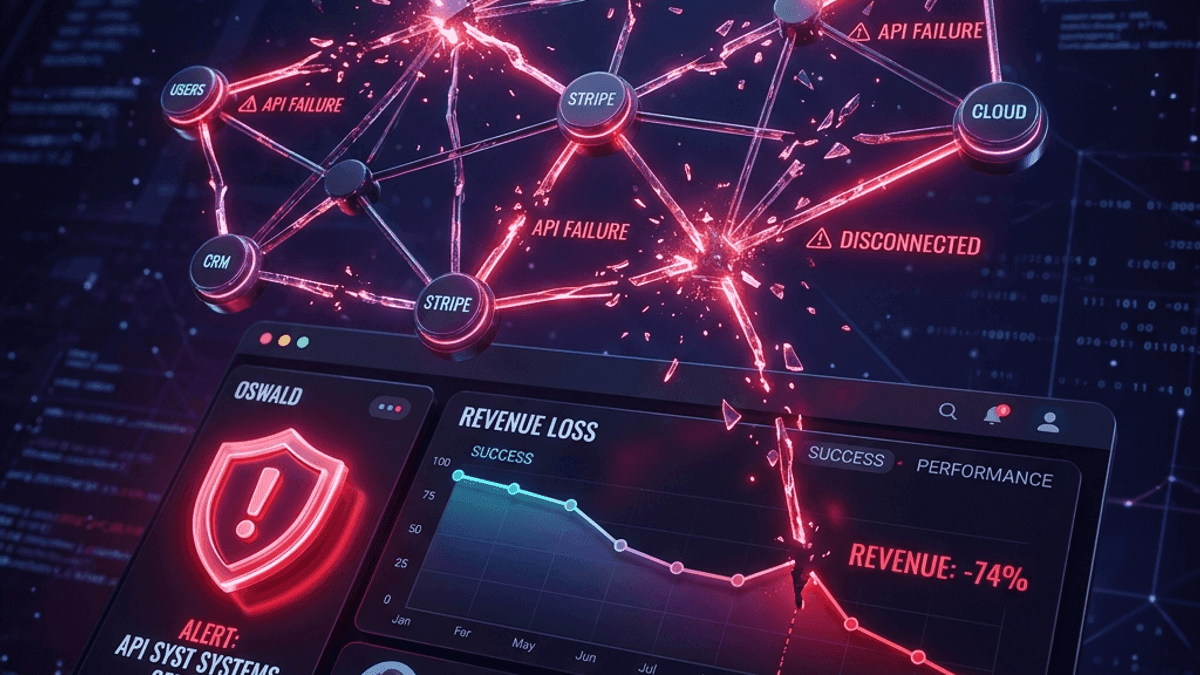
In modern software architectures, APIs are the invisible gears that drive the digital economy. They connect frontends to databases, process critical payments, route transactional emails, authorize users, and pipe AI models into our features. Because these dependencies operate behind the scenes, product teams often treat them as infrastructure abstractions that "just work."
However, when an API slows down, errors out, or fails completely, the abstraction shatters. To the end user, there is no distinction between your application code and the APIs it relies on. A failed payment gateway is a broken checkout. A slow authentication endpoint is a frozen login screen. A silent database timeout inside an API is a non-responsive dashboard.
API failures are the silent killers of modern SaaS, E-commerce, and mobile platforms. Unlike broad server crashes that trigger obvious alerts, API failures often manifest as partial, localized, or silent degradations that slip past traditional ping monitoring.
In this comprehensive guide, we will examine the direct and compounding business consequences of API failures across three critical dimensions: Customer Experience (CX), Revenue, and Customer Retention.
1. The Direct Impact on Customer Experience (CX)
Customer experience is the first line of defense for any digital business. Today's users expect sub-second interactions, intuitive workflows, and absolute reliability. When APIs fail to meet these expectations, customer experience degrades in three key ways:
Performance Friction and Latency Spikes
API latency is often more insidious than a complete outage. An API that responds in 5 seconds instead of 200 milliseconds is technically "up," but to the customer, the website feels sluggish and broken. Latency spikes in upstream APIs cascade into your application layer, keeping user interface elements in loading states, causing input fields to lag, and frustrating users. Studies show that a 100-millisecond delay in page load time can hurt conversion rates by 7%. When APIs lag, they introduce friction that damages user satisfaction.
Functional Failures and Partial Outages
Modern web apps are composed of dozens of micro-services. When one API fails—for example, the search indexing API or the email notification service—it creates a partial outage. Users might be able to log in, but they cannot search for products or receive verification emails. These functional gaps make the product feel half-baked and unreliable.
The Erosion of Digital Trust
Trust is extremely difficult to build and incredibly easy to lose. When a customer encounters repeated errors—like a "Something went wrong" banner or a spinning wheel during a critical checkout—their confidence in the company drops. If users feel that your platform is unstable, they will hesitate to input sensitive data, run mission-critical workflows, or trust your service with their business operations.
2. The Direct Leakage of Business Revenue
While poor customer experience is a subjective pain, revenue loss is a concrete operational reality. API failures drain company bottom lines through direct transactional loss, payment errors, and service level violations.
+-----------------------------------------------------------------+
|                       API FAILURE EVENT                         |
+-----------------------------------------------------------------+
                                 |
         +-----------------------+-----------------------+
         |                                               |
         v                                               v
+------------------+                            +------------------+
| Immediate Loss   |                            | Indirect Loss    |
+------------------+                            +------------------+
  - Failed checkouts                              - SLA Penalties
  - Blocked upgrades                              - High support cost
  - Interrupted ads                               - Dev time wasted
Abandoned Transactions and Checkout Failures
For e-commerce and transactional SaaS products, checkouts are highly sensitive entry points. If the payment processing API (such as Stripe or Adyen) degrades or fails during checkout, the transaction cannot complete. Customers are presented with payment errors, leading to immediate cart abandonment. Many of these users will not retry their transaction; they will simply go to a competitor. A 10-minute outage on a payment API can translate directly to thousands of dollars in lost, unrecoverable sales.
Involuntary Churn and Subscription Failures
For SaaS businesses relying on recurring subscriptions, API stability is vital. Subscription renewals depend on background billing engines communicating with payment gateways via APIs. If these APIs return logic errors, connection timeouts, or silent failures during batch charge requests, the payment fails.
When payments fail repeatedly, the billing system may automatically cancel the user's subscription or lock their account. This is called involuntary churn. The customer didn't want to leave, but because of a silent API payment failure, they were locked out. Statistics show that up to 30% of SaaS churn is caused by payment-related transaction failures, many of which stem from unmonitored API issues.
Service Level Agreement (SLA) Penalties
Enterprise customers demand strict Service Level Agreements (SLAs). If your API uptime falls below the contractually guaranteed threshold (e.g., 99.9%), your company is legally obligated to pay refunds, issue service credits, or face penalties. For high-volume API providers, a few hours of downtime can trigger massive financial penalties, erasing profit margins for entire quarters.
3. The Long-Term Impact on Customer Retention and Churn
Customer acquisition is expensive, while customer retention is the driver of sustainable growth. API failures directly threaten customer lifetime value (LTV) by accelerating churn and increasing the operational cost of maintaining users.
High Support Ticket Volumes and Resource Drain
When an API fails, support teams are hit with a wave of customer inquiries. Responding to hundreds of "Is the service down?" tickets drains customer support resources and slows down resolution times for other queries.
Furthermore, because these failures are often complex and vendor-dependent, support teams must escalate them to engineering. This triggers a reactive "firefighting" loop:
- An unmonitored API fails silently.
- Customers complain to support.
- Support alerts engineering.
- Engineers drop their planned roadmap work to investigate and patch the issue.
This operational loop drains productivity. Every hour an engineer spends chasing a silent API failure is an hour not spent building features that drive retention.
Customer Churn to Competitors
Reliability is a competitive feature. In highly saturated markets, customers have little tolerance for recurring outages. If your app consistently fails because your authentication API is slow or your file upload endpoint times out, customers will look for more reliable alternatives. High retention rates require a platform that users can depend on day in and day out.
Brand Reputation Damage
In the age of social media and developer forums, API outages are public knowledge. If your platform suffers public downtime, developers and IT leaders will write about it on forums like Hacker News, Reddit, or Twitter. This public record makes it significantly harder to sign new enterprise accounts, increases your Customer Acquisition Cost (CAC), and damages your brand's market position.
How to Protect Your Business: The Role of Proactive Monitoring
You cannot fix what you cannot see. Relying on customer complaints to detect API failures is the slowest, most expensive, and most damaging strategy available. To safeguard customer experience, revenue, and retention, teams must move toward proactive API monitoring.
+-----------------------------------------------------------------+
|                   PROACTIVE MONITORING FLOW                     |
+-----------------------------------------------------------------+
  [Synthetic Check] -> [Assert Schema & Data] -> [Validate Latency]
         |                     |                      |
         +---------------------+----------------------+
                               |
                               v
                     [Real-Time Alerting]
                               |
            +------------------+------------------+
            |                                     |
            v                                     v
     [Automated Fallback]                  [Fix Before User Sees]
An effective API monitoring system should include:
- Payload and Schema Validation: Do not just check for a
200 OKstatus code. Assert that the API response contains correct data, non-empty arrays, and matches your expected JSON schema. - Percentile Latency Tracking (P95/P99): Look beyond average response times. Track tail latency to catch slow API calls that affect your most active users.
- Multi-Region Checks: Run API monitors from global locations to ensure that regional network routing or CDN issues are caught immediately.
- Integration and Workflow Testing: Monitor multi-step synthetic API flows (e.g., authenticate, fetch data, update profile, clean up) to verify logic and state stability.
- Real-time Alerting & Status Pages: Push alerts to your incident response tools and automatically update public status pages to communicate transparently during degradations.
Conclusion
API failures are not just minor technical bugs; they are core business risks. When APIs fail, they disrupt the customer journey, leak revenue during checkouts, trigger SLA penalties, drive involuntary churn, and exhaust your development resources.
In a world where your software is only as strong as its weakest API dependency, investing in robust, multi-region API monitoring is a fundamental business necessity. By proactively tracking API health, validating payload correctness, and identifying latency bottlenecks before they reach your users, you protect your brand, retain your customers, and secure your revenue.
UpScanX provides comprehensive, real-time API monitoring, payload validation, and multi-region uptime tracking designed to keep your digital operations reliable. Sign up for a free account today to stop API failures from affecting your customer experience and bottom line.