


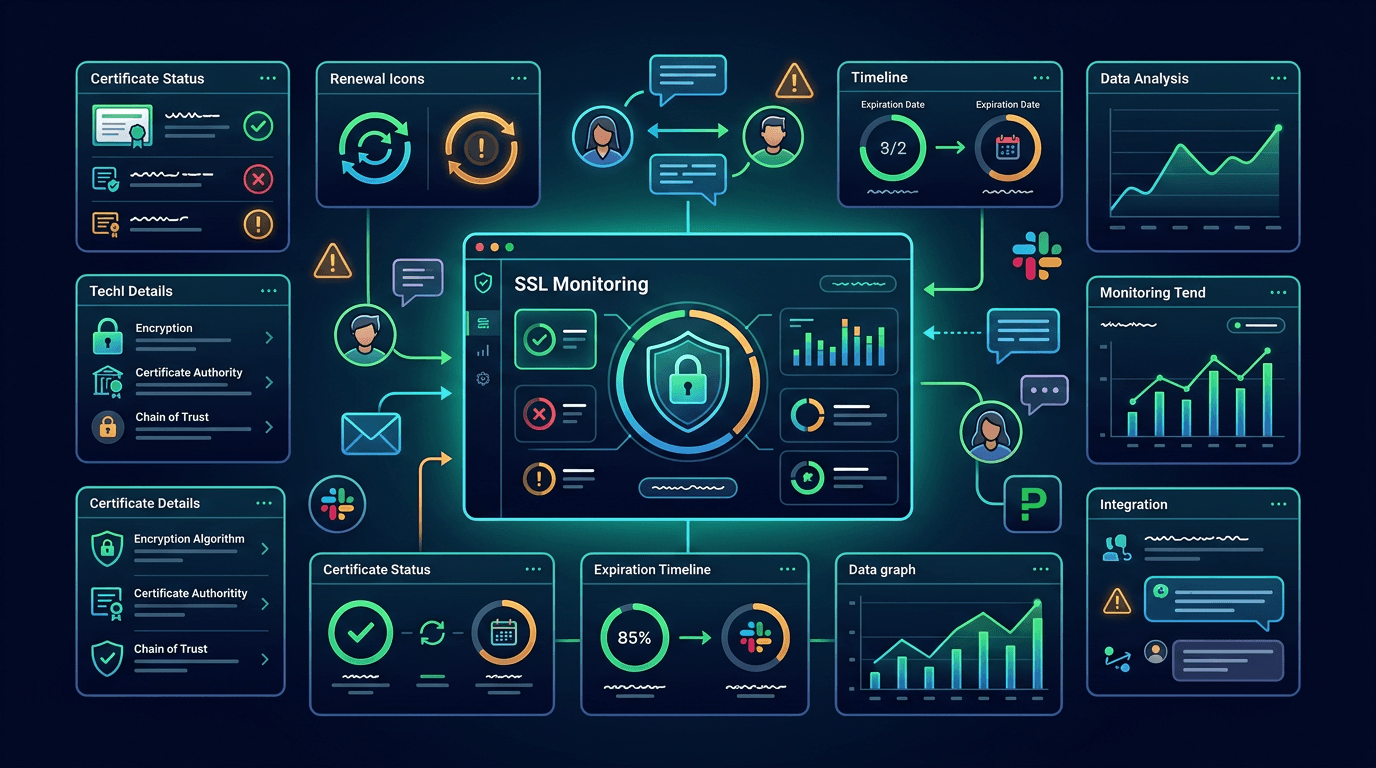
The best SSL certificate monitoring tools for growing SaaS teams are the ones that do more than send an expiration reminder. As infrastructure grows, certificate risk spreads across marketing sites, customer subdomains, APIs, load balancers, Kubernetes ingress, CDN edges, and third-party integrations. At that point, a basic alert on one public domain is not enough. Teams need visibility, automation, routing, and proof that renewed certificates are actually live in production.
That is why the right tool depends on where your SaaS team is today. Some teams need a simple all-in-one monitoring platform. Others need certificate discovery, internal PKI visibility, or Kubernetes-native metrics. The best choice is the tool that matches your operational complexity without forcing your team into manual certificate management again.
What Growing SaaS Teams Need From SSL Monitoring
Before comparing tools, it helps to define the actual job. Growing SaaS teams usually need SSL monitoring that covers five things at once:
- expiration alerts before certificates become urgent
- validation of the full certificate chain
- monitoring for SAN and hostname coverage
- renewal and deployment verification
- integrations with the team's incident workflow
This becomes especially important as the company scales. A small startup may manage a few domains manually. A growing SaaS product may suddenly have customer-specific hostnames, partner endpoints, regional traffic paths, and Kubernetes-managed certificates renewing on different schedules. If one of those paths breaks, the business impact can be immediate even though the rest of the infrastructure looks healthy.
The Best Tool Categories for SaaS Teams
There is no single best tool for every company. Instead, the strongest options usually fall into a few categories.
1. All-in-One Monitoring Platforms
For many SaaS teams, the best option is an all-in-one monitoring platform that includes SSL checks alongside uptime, API, and domain monitoring. This is usually the most practical choice for growing companies because certificate health rarely fails in isolation. Teams often need to correlate SSL problems with uptime incidents, DNS changes, or regional outages.
UpScanX fits this category well for teams that want SSL monitoring as part of a broader operational workflow. It combines certificate expiration tracking, chain validation, SAN awareness, and alerting with other website and infrastructure monitoring capabilities. That matters because SaaS teams usually do not want a separate certificate-only dashboard if the real outcome is still an incident that touches availability, trust, and customer traffic.
Uptime.com also represents this category, offering SSL expiry monitoring inside a broader availability platform. Tools like this are strong for teams that want quick implementation, central alerting, and certificate awareness without building their own observability stack.
This category is best when:
- your team wants one dashboard for uptime and certificate health
- you need Slack, PagerDuty, email, or webhook alerts
- you monitor both public pages and customer-facing APIs
- you want fast adoption without operating extra infrastructure
2. Discovery-First Certificate Visibility Tools
Some teams already have general monitoring, but what they lack is certificate visibility across their estate. In that case, discovery-first tools can be useful. These products focus on finding certificates, tracking expiration, and reporting on external certificate exposure across many domains and environments.
Qualys CertView is a good example of this approach. It focuses on discovering and monitoring internet-facing certificates, giving teams a way to see what is exposed and when those certificates are at risk. For organizations that have inherited domains, acquired products, or inconsistent certificate ownership, discovery can be as valuable as alerting.
This category is best when:
- you are unsure how many public certificates you actually have
- your organization has many business units or inherited domains
- external visibility matters more than deep deployment automation
- compliance reporting is part of the requirement
The limitation is that discovery-oriented tools are often strongest at inventory and alerting, but not always at verifying the full renewal and deployment workflow on modern application stacks.
3. PKI-Focused and Internal Certificate Monitoring Tools
As SaaS products mature, certificate risk often moves beyond public websites. Teams start managing internal APIs, service identities, private certificate authorities, mTLS, and hybrid environments. At that point, public-domain SSL checks alone are not enough.
Tools such as SSL Guardian fit this need more directly because they are designed for broader certificate visibility, including internal and private certificate environments. This matters for larger SaaS teams where customer-facing trust depends on internal certificate reliability as well. A broken internal certificate can interrupt API gateways, service-to-service communication, CI/CD systems, or customer provisioning workflows even if the homepage still looks fine.
This category is best when:
- your environment includes internal PKI or private trust chains
- you need visibility beyond public HTTPS endpoints
- you run hybrid cloud or regulated workloads
- service-to-service trust matters operationally
These tools are often more sophisticated, but that also means they may be heavier than what an early-stage SaaS team actually needs.
4. Kubernetes-Native Certificate Monitoring
For SaaS teams running heavily on Kubernetes, the best certificate monitoring setup is sometimes not a standalone product at all. It can be a Kubernetes-native certificate workflow built around cert-manager, Prometheus, Grafana, and Alertmanager or OpenTelemetry.
This approach gives teams very deep visibility into certificate expiration timestamps, renewal timing, readiness state, and challenge failures. It is especially strong for platform teams already operating Kubernetes observability at scale. Because cert-manager exposes metrics, teams can alert on certificates nearing expiration, failed renewals, or stalled issuance workflows.
This category is best when:
- your certificate lifecycle is already managed in Kubernetes
- your team is comfortable operating Prometheus or OpenTelemetry
- you want deep internal metrics and engineering-level observability
- platform engineering prefers native instrumentation over SaaS dashboards
The trade-off is complexity. This approach is powerful, but it usually requires more engineering effort to turn raw metrics into usable certificate operations workflows for a broader SaaS team.
5. Renewal Automation Platforms
Another category to consider is the platform that combines monitoring with automated renewal and deployment. These tools matter for teams where the main risk is not discovery, but operational follow-through. A certificate can renew successfully in theory and still never make it onto the production edge.
Tools like CertProtector position themselves around this problem by combining monitoring with automation, installation, and renewal workflows. This can reduce manual effort significantly for teams that manage many certificates but do not want to build custom deployment pipelines.
This category is best when:
- you want fewer manual certificate touchpoints
- your team manages many domains but limited operations headcount
- renewal verification is more painful than discovery
- the business wants predictable, low-drama certificate operations
The main consideration here is platform fit. If your stack is unusual, multi-cloud, or deeply customized, you need to make sure the automation model matches your real deployment path.
How SaaS Teams Should Choose Between These Tools
The easiest mistake is choosing based on feature lists alone. Growing SaaS teams should choose based on the operational failure they are most likely to experience next.
If the biggest risk is simply not noticing that a certificate is expiring, an all-in-one monitoring platform is often enough. If the bigger risk is not knowing what certificates exist across the business, discovery-first tools are more useful. If internal PKI and private certificates are involved, a PKI-focused platform makes more sense. If everything is already Kubernetes-native, cert-manager observability may be the strongest fit. If renewal and deployment are the painful parts, automation-first tools deserve more weight.
In practical terms, the best SSL certificate monitoring tool for a growing SaaS team usually has these characteristics:
- clear expiration and renewal alerts
- full chain and hostname validation
- multi-domain and multi-subdomain support
- integration with Slack, PagerDuty, or webhooks
- proof of live deployment after renewal
- enough simplicity that the team actually uses it
That last point matters more than many teams admit. The most feature-rich tool is not the best tool if nobody trusts the workflow or checks the alerts.
Where UpScanX Fits Best
UpScanX is strongest for SaaS teams that want certificate monitoring as part of a broader website reliability and trust strategy. Instead of isolating certificate health into a separate niche workflow, it connects SSL monitoring with uptime, API monitoring, domain monitoring, and alerting. For growing teams, that integrated view often reduces operational friction because the same incident usually affects multiple layers at once.
If your team wants a fast-to-adopt platform that helps prevent expiration issues, validate certificate health, and keep public trust visible without building everything internally, this category is usually the right place to start.
Final Thoughts
The best SSL certificate monitoring tools for growing SaaS teams are not simply the ones with the longest feature list. They are the ones that reduce operational risk at your current stage of growth. For some teams, that means a unified monitoring platform like UpScanX or Uptime.com. For others, it means discovery-heavy tools like Qualys CertView, PKI-focused visibility platforms like SSL Guardian, Kubernetes-native observability around cert-manager, or automation-first services like CertProtector.
What matters most is whether the tool helps your team answer the questions that actually prevent incidents: What certificates do we own? Which ones are close to expiring? Did renewal fail? Was the new certificate deployed everywhere? Will users and APIs trust what is live right now?
If a tool answers those questions clearly and early, it is doing the job that growing SaaS teams really need.