


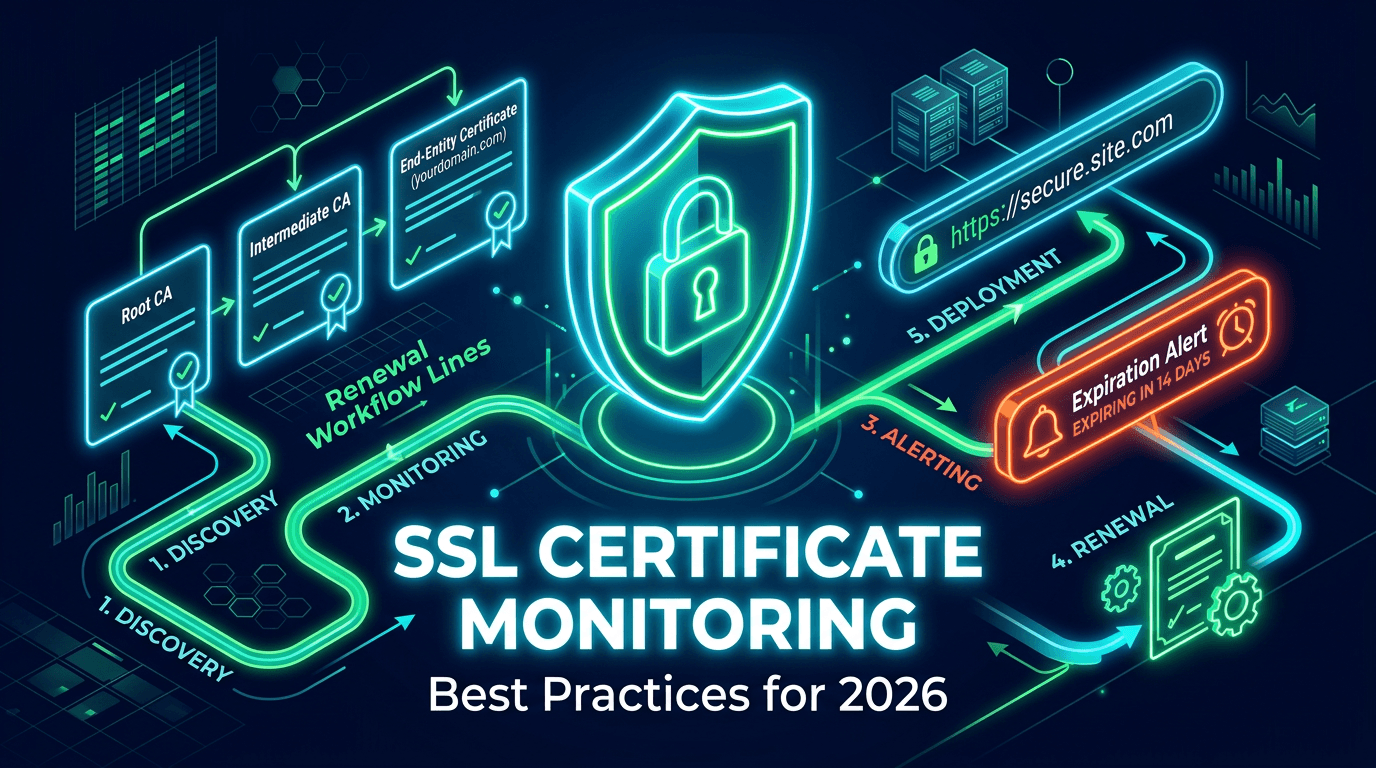
SSL certificate monitoring is no longer a nice-to-have task buried in an operations checklist. In 2026, it is a core reliability and trust discipline. When a certificate expires, a chain breaks, or a deployment rolls out the wrong SAN coverage, users are blocked by browser warnings immediately. Search engines may fail to crawl important pages, paid campaigns can send traffic into security errors, and support teams suddenly face a problem that feels much larger than the root cause.
The challenge is growing. Certificate lifecycles are getting shorter, infrastructures are becoming more distributed, and automated renewal alone is not enough. Teams now need monitoring that verifies the entire certificate lifecycle, not just the expiration date. This guide explains the best practices that keep HTTPS healthy, prevent trust failures, and help organizations avoid the most common certificate-related outages.
Why SSL Monitoring Matters More in 2026
The certificate landscape is changing fast. Public certificate lifetimes are moving toward shorter renewal windows, which means more frequent renewals, more deployment events, and more chances for operational mistakes. Manual spreadsheets and calendar reminders were already fragile. Under shorter certificate validity periods, they become dangerous.
At the same time, users have less tolerance for trust warnings than ever. One browser security message can kill a conversion, trigger internal escalation, or damage confidence in the brand. In industries like SaaS, finance, healthcare, and e-commerce, certificate health affects security posture, compliance, and revenue at once. That is why SSL monitoring should be designed as an always-on operational safeguard.
Best Practice 1: Track Expiration With Layered Alerts
Expiration monitoring is still the foundation. Every critical certificate should have several alert thresholds, not just one. A single "expires in 7 days" reminder is not enough for complex environments. A stronger structure includes planning alerts, action alerts, and emergency alerts.
A practical sequence looks like 60 days, 30 days, 14 days, 7 days, and 1 day before expiration. The earlier alerts are for planning and ownership confirmation. The later alerts are for escalation if something has gone wrong. This matters even when auto-renew is enabled, because the most common failures are not just missed renewals. They are failed renewals, stalled validations, and incomplete deployments after renewal.
Best Practice 2: Validate the Full Certificate Chain
Many teams focus only on the leaf certificate and miss the real problem. Browsers trust a full chain, not just the server certificate. If an intermediate certificate is missing, outdated, or served in the wrong order, users can still receive trust errors even when the visible certificate looks valid.
Monitoring should validate the full chain presented to clients, including intermediate certificate health and trust relationships. This is especially important after renewals, certificate authority changes, CDN updates, or infrastructure migrations. Chain issues are common in distributed systems because different edges, proxies, or load balancers may present different results depending on region or route.
Best Practice 3: Monitor SAN Coverage After Every Renewal
Subject Alternative Names define which domains and subdomains a certificate covers. This matters more than many teams realize. During a renewal or reissue, it is easy to accidentally omit a subdomain, remove a host, or change coverage assumptions. The result is usually a silent risk until one environment starts showing certificate mismatches.
Strong monitoring checks SAN coverage continuously and compares it with the expected domain inventory. If a certificate no longer includes a required domain, the system should alert immediately. This is especially important for wildcard certificates, multi-domain certificates, customer-specific hostnames, and growing SaaS infrastructures where hostnames evolve often.
Best Practice 4: Verify Deployment, Not Just Issuance
One of the most dangerous assumptions in certificate management is believing renewal success equals safe deployment. It does not. A certificate can renew successfully in your automation pipeline but never reach the live CDN, reverse proxy, Kubernetes ingress, edge node, or load balancer that serves real users.
SSL monitoring should always verify what users actually receive when they connect to the service. That means checking the live endpoint, reading the presented certificate, and confirming issuer, expiration, SANs, and chain health from the outside. This closes the gap between certificate operations and real production reality, which is where most outages happen.
Best Practice 5: Monitor From Multiple Locations
Certificate problems are not always global. One region might serve a stale certificate from cache. One CDN edge might have a broken chain. One IPv6 path might expose a different certificate than IPv4. If you only validate from a single network location, you can miss critical inconsistencies.
Best practice is to test certificates from multiple regions and, where relevant, through different protocols or network paths. This gives teams fast context when incidents happen. Instead of asking whether the problem is universal, you already know whether it is limited to a market, a CDN edge, or a particular network route. Multi-perspective SSL validation is especially valuable for brands with global traffic.
Best Practice 6: Include SEO and Conversion Risk in Your Model
SSL problems are not only security issues. They are also growth issues. If a high-ranking landing page starts showing browser warnings, users will bounce instantly. Search engines may fail to crawl pages consistently. Paid traffic routed to affected URLs wastes budget and hurts campaign performance.
That is why SSL monitoring should include a business-priority view. Certificates serving revenue pages, login flows, checkout pages, documentation, and SEO-critical templates deserve higher priority and faster escalation. This simple alignment helps teams respond based on impact, not just technical severity. In practice, the most valuable certificate is usually not the one with the highest complexity. It is the one protecting the path customers use most.
Best Practice 7: Build a Certificate Inventory With Ownership
A hidden certificate cannot be monitored well. Every organization should maintain an inventory of active certificates, covered domains, issuing authorities, expected renewal methods, and responsible owners. This should include production, staging, internal tools, APIs, email systems, VPN endpoints, and legacy hosts that still matter operationally.
Ownership is essential. Every critical certificate should belong to a team or individual who is accountable for renewal, validation, and incident response. Without ownership, alerts drift into shared channels and issues stay unresolved longer than necessary. SSL incidents are often not technical mysteries. They are operational ownership failures.
Best Practice 8: Watch for Policy and Lifecycle Changes
The public certificate ecosystem keeps evolving. Certificate lifetime reductions, validation requirements, CA policy changes, and browser trust updates can all change how your environment needs to operate. Teams that ignore these shifts often discover them too late, when a legacy process no longer works.
Monitoring should be supported by a review process that tracks external policy changes and internal readiness. If certificate validity windows are getting shorter, are your renewal flows ready? If domain control validation reuse rules change, will your automation still pass? Operational readiness is part of certificate monitoring because lifecycle risk begins long before expiration day.
Best Practice 9: Include Revocation and Protocol Hygiene
Expiration is not the only certificate risk. Weak protocol configurations, revocation issues, and deprecated cipher support can all erode trust or expose security problems. Monitoring should include at least a baseline check for TLS posture, protocol negotiation, and related trust signals where appropriate.
This does not mean every monitoring platform must become a full security scanner. But it should help identify visible misconfigurations that affect client trust and browser behavior. Teams responsible for public HTTPS should treat SSL monitoring as a bridge between operations and security, not as a narrow renewal reminder system.
Best Practice 10: Test Alerts Before You Need Them
Monitoring workflows fail quietly when nobody tests them. The certificate may be tracked, but the email goes to the wrong list. The Slack channel may exist, but nobody watches it after hours. The escalation rule may be configured, but phone notifications are disabled. These failures are common and avoidable.
Run alert drills against non-critical certificates or test environments. Confirm that the right people receive warnings at each threshold. Validate acknowledgments, escalations, recovery notices, and ownership handoffs. When a real certificate issue happens, your team should already know the alert system works.
Common SSL Monitoring Mistakes to Avoid
There are several repeated mistakes across teams. The first is treating auto-renew as a substitute for monitoring. Auto-renew lowers risk, but it does not remove the need to verify issuance and deployment. The second is monitoring only production websites while ignoring APIs, email systems, and internal tools. Those systems can fail just as hard and often create wider operational damage.
Another major mistake is assuming a wildcard covers everything. It does not. Wildcards have scope limits, and nested subdomain structures can surprise teams during expansion. Finally, many teams ignore certificate history and only react to the current state. Without historical visibility, it is harder to spot recurring CA issues, deployment drift, or repeated ownership failures after each renewal cycle.
What to Look for in an SSL Monitoring Platform
The best SSL monitoring tools combine certificate visibility with operational usability. At minimum, they should support expiration alerts, full chain validation, SAN awareness, multi-location checks, clear alert routing, and historical visibility. More advanced teams benefit from integrations with on-call tools, maintenance workflows, and broader uptime or domain monitoring systems.
It also helps when certificate monitoring can be viewed alongside related systems. For example, if a certificate issue happens at the same time as a regional uptime incident or DNS change, teams can correlate signals faster. That integrated view is much more useful than isolated certificate reminders.
The strongest SSL monitoring strategy in 2026 is not just about avoiding expiration. It is about protecting trust, search visibility, and service continuity across a more automated and more distributed infrastructure. Expiration alerts, chain validation, SAN coverage checks, deployment verification, and ownership clarity all work together to reduce risk.
If your organization depends on HTTPS, certificate health deserves the same operational maturity as uptime, API reliability, and domain security. The teams that treat SSL monitoring as part of continuous reliability will prevent more incidents, respond faster, and protect customer trust far better than teams still relying on manual reminders.