


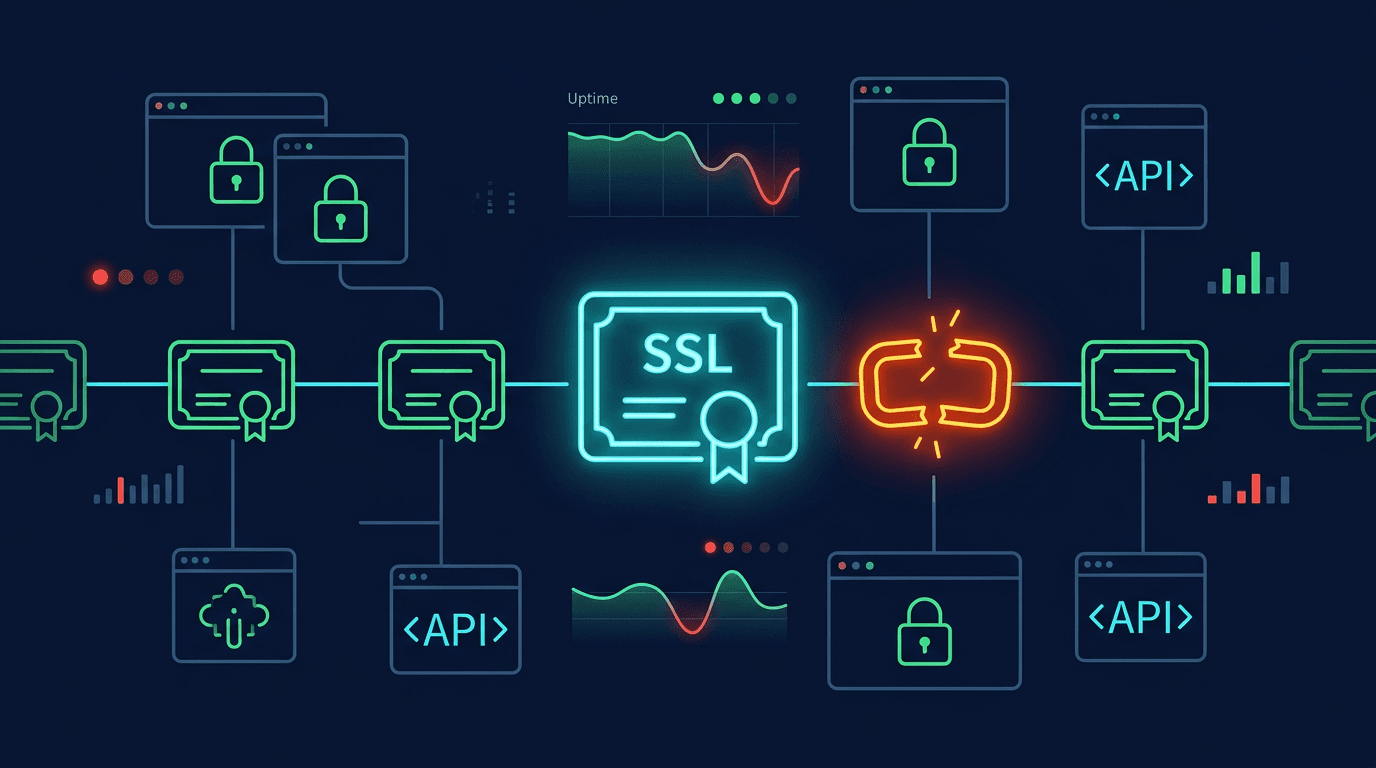
Certificate chain validation is important for website availability because a website is not truly available if browsers, apps, or APIs cannot trust the HTTPS connection. A server may be online, fast, and fully functional at the application level, but if the certificate chain is incomplete or broken, users still hit browser warnings, API clients fail TLS handshakes, and business-critical pages become effectively inaccessible.
That is why certificate chain health belongs in the same conversation as uptime. Availability is not only about whether the server responds. It is about whether real clients can connect successfully and securely. If trust breaks, the website may still be "up" from an infrastructure perspective while being unusable for actual visitors.
What Certificate Chain Validation Actually Means
When a browser connects to an HTTPS site, it does not trust the leaf certificate on its own. It validates a chain of trust from the server certificate through one or more intermediate certificates up to a trusted root certificate authority already stored in the operating system or browser trust store.
For that process to work, the server must present the correct certificate chain. In most cases, that means:
- the leaf certificate for the domain
- the required intermediate certificate or certificates
- the certificates in the correct order
The root certificate usually does not need to be sent because the client already trusts it. But if the intermediate certificates are missing or incorrect, the client may fail to complete the trust path. That is when users start seeing certificate warnings even though the certificate itself looks valid.
Why This Affects Availability So Directly
Certificate chain failures behave like availability incidents because they stop successful connections. The page may still return HTML, the API may still be running, and monitoring that checks only for TCP reachability may still report green. But the actual HTTPS session fails.
From the user's perspective, there is no practical difference between:
- a server that is down
- a page that times out
- a browser-blocking certificate warning
All three outcomes stop access. That is why chain validation is not just a cryptography detail. It is part of whether the service is reachable in the real world.
Missing Intermediate Certificates Are a Common Cause
One of the most common production SSL issues is a missing intermediate certificate. This happens when the site serves the leaf certificate but fails to include the certificate or certificates needed to connect it to a trusted root authority.
The result is often confusing because the problem does not always look consistent. Some browsers may appear to work, especially if they cached the intermediate previously or can fetch it dynamically. Other clients fail immediately, including:
- first-time visitors
- mobile apps
- API clients
curland command-line tools- monitoring agents
- integrations and webhooks
This inconsistency makes chain problems especially dangerous. Teams may test the site on one familiar browser and assume everything is fine, while customers or automated systems are already failing elsewhere.
Why Broken Chains Damage Trust So Fast
Users do not care whether the problem is a missing intermediate certificate, a hostname mismatch, or an expired leaf certificate. They just see a warning that the site may be unsafe. Once that warning appears, trust drops immediately.
That matters for public websites because the browser experience is often the first and only impression a visitor gets. A user trying to log in, pay, submit a form, or view a product page will rarely pause to interpret a TLS chain issue. They will simply leave.
This is why certificate chain validation supports not only technical uptime, but also conversion, retention, and brand trust. Availability without trust is not real availability.
APIs and Internal Services Break Too
Certificate chain validation matters beyond websites. APIs, internal services, service-to-service calls, and webhooks often enforce certificate trust more strictly than browsers. These clients may not fetch missing intermediates automatically, and they usually fail closed.
That creates a serious operational risk. A broken chain on an API gateway can interrupt:
- authentication flows
- payment requests
- partner integrations
- internal dashboards
- CI/CD pipelines
- observability tooling
In these environments, the service may appear healthy in local tests but fail in production traffic paths that depend on full TLS validation. This is one reason certificate chain issues often create incidents that look larger than the original misconfiguration.
Why Chain Errors Can Hurt Search Visibility
Search visibility also depends on a valid HTTPS experience. Google strongly prefers HTTPS pages and reports certificate-related problems in Search Console's HTTPS reporting. If important pages are served with invalid certificate configurations, Google may struggle to evaluate them correctly, especially when the issue is site-wide or persistent.
A broken chain can therefore create two layers of damage at once:
- users receive trust warnings and abandon the page
- search systems see an unhealthy HTTPS setup
For SEO-critical pages, that combination can reduce both discoverability and conversion performance. Even when the ranking effect is not immediate, the business effect often is.
Why Chain Problems Often Appear After Renewals
Many certificate chain incidents happen after renewal, reissue, or infrastructure migration. The new certificate may be valid, but the server configuration was not updated with the correct bundle. In other cases, a CDN, load balancer, or reverse proxy still serves an outdated chain while another environment is already correct.
This is why teams should never assume that successful renewal means successful deployment. Chain validation needs to be part of post-renewal verification. The important question is not whether a new certificate exists somewhere in the system. It is whether the live endpoint presents a complete and trusted chain to every real client.
Why Single-Location Testing Is Not Enough
Certificate chain issues can vary by region, network path, and client type. A site might work in Chrome on a developer laptop but fail in a mobile app, a server-side HTTP client, or a monitoring probe from another location.
That is why website availability checks should include external chain validation from multiple environments. If you only test from one browser on one machine, you may miss exactly the path that customers or integrations are using. Multi-perspective validation is especially important for global traffic, CDNs, multi-region infrastructure, and edge-heavy deployments.
What Good Chain Validation Monitoring Looks Like
Strong monitoring does more than tell you when a certificate expires. It should also validate whether the full certificate chain is trusted on the live endpoint. A practical monitoring setup should check:
- whether the server presents the complete chain
- whether intermediate certificates are valid and correctly ordered
- whether the hostname matches the certificate
- whether the same chain is visible across regions
- whether post-renewal deployments changed the trust path
This turns chain validation into an ongoing operational control instead of a one-time SSL setup task. That matters because certificate chains can break during routine infrastructure changes, not only during major incidents.
Common Mistakes to Avoid
Teams often make the same mistakes with chain validation:
- checking only the leaf certificate
- assuming browser success means all clients are safe
- validating from one local environment only
- failing to test after certificate renewal
- ignoring API and webhook endpoints
- relying on internal automation signals instead of external endpoint checks
These mistakes happen because certificate chain health feels invisible when it is working. But when it breaks, the consequences become very visible very quickly.
Final Thoughts
Certificate chain validation is important for website availability because HTTPS trust is part of real availability. A website is not meaningfully online if users, crawlers, apps, or APIs cannot complete a secure connection. Missing intermediates, incorrect ordering, stale bundles, and partial deployments can all create that failure even when the application itself is healthy.
That is what makes chain validation so important operationally. It protects the layer between infrastructure uptime and user access. When the chain is correct, trust stays invisible and the service works normally. When the chain breaks, the website may remain technically online while becoming unavailable to the people and systems that matter most.
For any business that depends on secure web traffic, chain validation should be monitored continuously, especially after renewals and infrastructure changes. It is one of the simplest ways to prevent a silent trust problem from turning into a visible availability incident.