


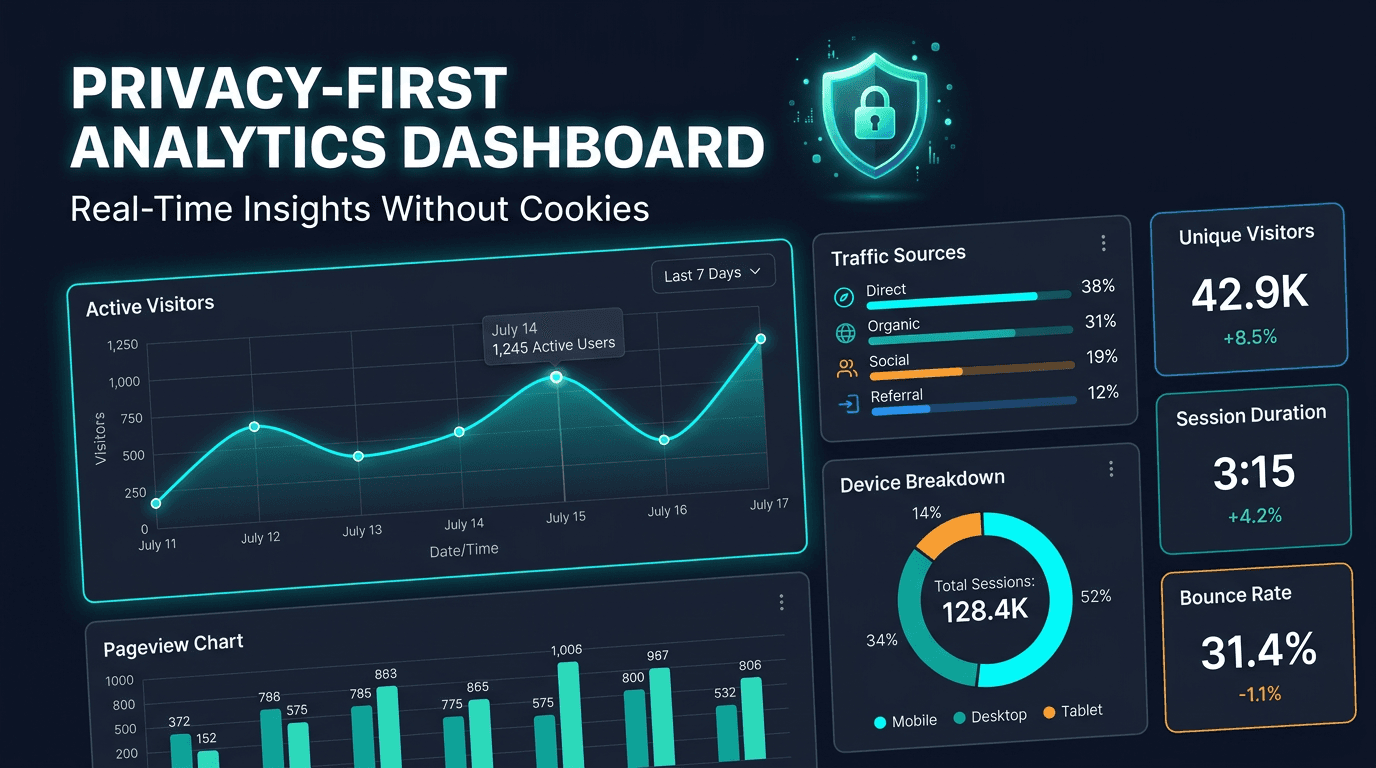
Cookieless website analytics is becoming one of the most important shifts in digital measurement. For years, many companies accepted a trade-off: use heavy analytics stacks, trigger consent flows, lose part of the audience from measurement, and then make decisions using incomplete data. In 2026, that trade-off is no longer attractive for many teams. Privacy expectations are higher, implementation simplicity matters more, and organizations want data they can actually trust without creating unnecessary friction for users.
That is why cookieless analytics is gaining momentum. It provides traffic, source, and engagement visibility without depending on traditional persistent cookies in the same way. The result is a lighter, cleaner analytics model that can improve data coverage, reduce compliance complexity, and make dashboards easier to operationalize across product, marketing, and engineering teams. This guide explains why cookieless analytics matters and what teams should look for in practice.
Why Traditional Cookie-Based Analytics Creates Friction
Cookie-based analytics often comes with several hidden costs. Consent banners interrupt the user journey. Some visitors reject tracking, which means those visits vanish from the dataset. Scripts can be large and performance-heavy. Legal and policy review becomes more complex. Engineering teams end up maintaining analytics implementations that feel disproportionate to the insight they provide.
This becomes especially frustrating when the missing data is not random. The visitors who reject consent may represent important audience groups, devices, regions, or behaviors. That means analytics no longer reflects the website as a whole. Teams may think traffic dropped or engagement changed when the real problem is simply inconsistent observability.
What Cookieless Analytics Changes
Cookieless analytics aims to measure website activity with a lighter privacy model. Instead of relying on long-lived identifiers for individual tracking, it focuses on aggregate, session-level, or short-lived measurement approaches that reduce user-level persistence. The exact implementation varies by platform, but the general goal is the same: useful measurement with less personal tracking overhead.
For teams, the practical advantage is clarity. You can still see traffic patterns, landing-page performance, traffic source breakdowns, status-code trends, and device distribution, but without depending on a measurement approach that creates as much friction. This often leads to better data coverage and simpler governance.
Why This Matters for SEO Teams
SEO teams need reliable visibility into landing pages, traffic trends, referrers, and content engagement. They do not necessarily need intrusive identity tracking to get that value. In fact, a lighter analytics system can often be more useful because it reduces measurement gaps caused by consent rejection.
Cookieless analytics helps SEO teams answer important questions more confidently. Which landing pages are attracting traffic? Which content is growing? Which referrers matter? Which pages are seeing rising bounce or weak engagement? Because the measurement model is often lighter and broader in coverage, the answers may be more representative of actual search-driven behavior.
Why This Matters for Product and Engineering
Cookieless analytics is not only a marketing topic. Product and engineering teams also benefit because implementation is often simpler, lighter, and more aligned with performance goals. A smaller script means less drag on the page. A cleaner model means fewer tag-related surprises. Technical metrics such as status-code distribution or page-level activity can also become easier to tie into broader monitoring.
This matters because the modern website is not only a marketing asset. It is also a product surface. Product launches, pricing changes, onboarding improvements, and feature rollouts all benefit from analytics that is fast, privacy-aware, and easy to connect to operational context.
The Core Metrics You Still Need
A good cookieless analytics platform should still provide the fundamentals: page views, unique visitor estimation, top pages, landing pages, referrers, traffic channels, device and browser breakdowns, and time-based trend views. The absence of traditional cookies should not mean the absence of useful dashboards.
The strongest systems also include technical signals such as status codes, real-time activity, and basic event visibility. These help teams connect user behavior with technical health. For example, a bounce increase tied to a rise in 404s is much easier to interpret than either signal alone.
Real-Time Visibility Is a Big Advantage
One of the biggest practical benefits of modern cookieless analytics is real-time or near-real-time visibility. This matters during campaigns, product launches, migrations, content releases, and incident response. If active visitors suddenly drop, if one landing page spikes, or if traffic sources change unexpectedly, teams want to see that immediately.
Real-time visibility also improves cross-functional collaboration. Marketing can watch campaign behavior, product can observe adoption, and engineering can compare those shifts with uptime or performance changes. That shared timing context makes analytics more actionable.
Consent Friction Affects Data Quality
Many teams think of consent banners mainly as a legal topic, but they are also a data quality topic. Every rejected banner can create a missing visitor in the analytics set. Over time, that makes traffic reporting less representative. The more privacy-conscious the audience, the bigger the measurement gap may become.
Cookieless analytics helps reduce that distortion by using a less invasive measurement model. The result is not perfect omniscience, but it is often a better operational picture of the site's real activity. For growth and content teams, that can be more valuable than more granular tracking with weaker overall coverage.
Lighter Analytics Supports Site Performance
Analytics should not meaningfully harm the performance it is trying to measure. Yet many legacy stacks do exactly that. Heavy scripts, third-party tags, and layered marketing code can slow pages down and complicate debugging. This is one reason privacy-first and cookieless analytics tools are appealing. They often reduce weight and simplify the frontend surface area.
That is useful for SEO as well. Faster pages improve user experience and support technical performance goals. A measurement solution that protects site speed while still providing insight is often a better long-term choice than one that creates more load and more consent friction.
Common Mistakes to Avoid
One common mistake is assuming cookieless analytics means low-quality analytics. The better framing is different: it usually means less invasive analytics focused on practical insight rather than identity-heavy tracking. Another mistake is expecting it to mirror every feature of old-school marketing suites. The value proposition is not "same thing, different label." It is cleaner, lighter, more privacy-aware visibility.
Teams also make the mistake of isolating analytics from technical monitoring. Traffic trends become much more useful when they can be compared with uptime, performance, API health, or status-code shifts. Cookieless analytics works best when it helps connect behavior and system quality together.
What to Look for in a Cookieless Analytics Platform
The best platforms provide clean dashboards, real-time visibility, strong landing-page analysis, source and referrer views, device and browser insights, and enough technical context to support operational use. It helps if the system is easy to deploy, light on the frontend, and integrated with broader monitoring or reporting tools.
You should also look for clear data design. Teams need to understand what the platform measures, how it estimates key metrics, and how to interpret the results. Transparency increases trust, and trust determines whether the dashboard actually gets used in decision-making.
Cookieless website analytics matters in 2026 because organizations want insight without unnecessary friction. They want better traffic visibility, lighter scripts, fewer compliance headaches, and analytics that still help with SEO, product, and technical decision-making. For many teams, privacy-first measurement is not just a values choice. It is a practical improvement.
When implemented well, cookieless analytics gives teams a cleaner view of what is happening on the website while staying lighter, simpler, and easier to operationalize. That combination is exactly why it is becoming a more attractive default for modern digital teams.