


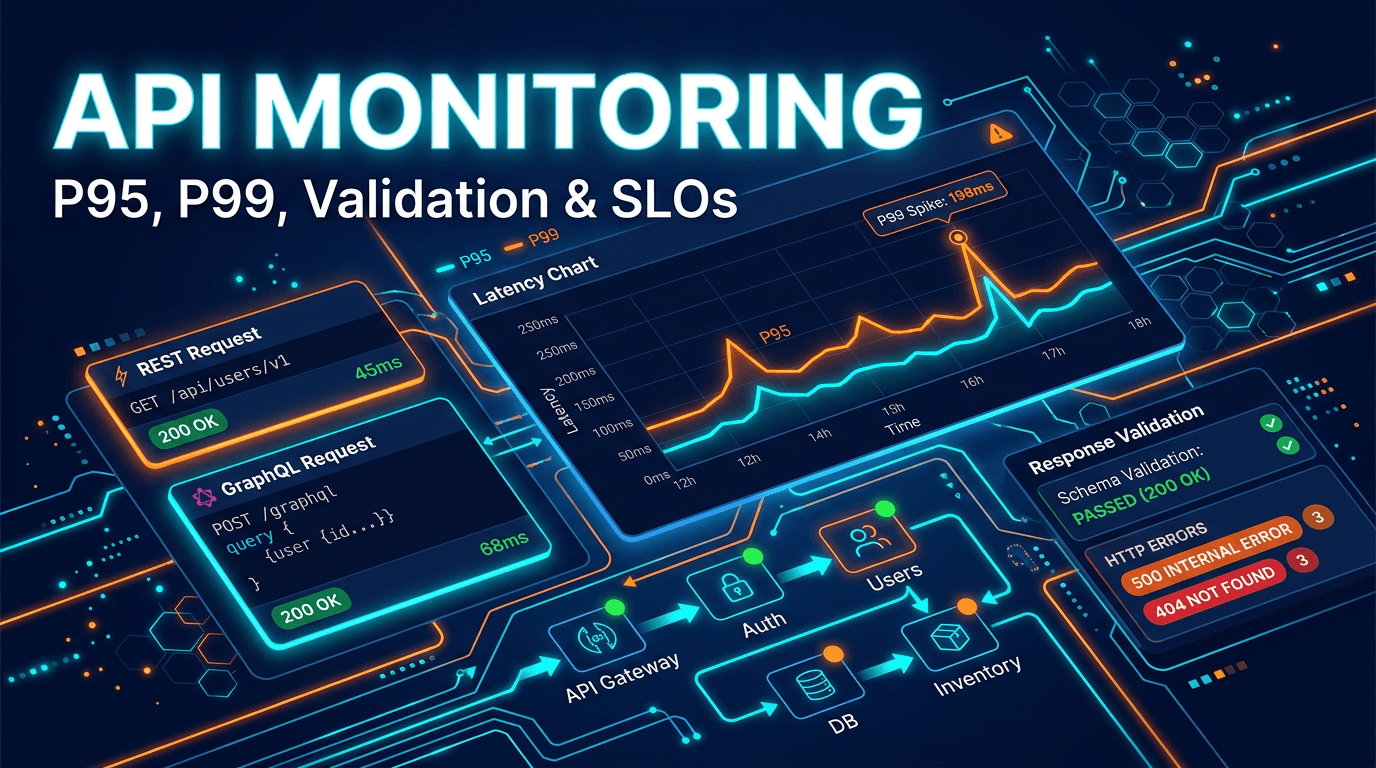
API monitoring becomes much more valuable when it is tied to service level objectives. Without SLOs, teams often collect lots of metrics but struggle to decide what is acceptable, what is urgent, and where reliability work should be prioritized. One engineer sees a spike and calls it noise. Another sees the same graph and calls it a customer-facing issue. The team wastes time because no shared objective exists.
SLO-based API monitoring solves that problem by turning availability and performance into explicit targets. Instead of asking whether an endpoint looks healthy, teams ask whether it is meeting the agreed level of service. That shift sounds simple, but it has a big effect on engineering focus, alert quality, and product reliability. In 2026, SLOs remain one of the most effective ways to make API monitoring truly operational.
What an API SLO Actually Means
A service level objective defines the expected level of reliability for a service over a given period. For APIs, that often means a percentage of requests that must succeed within a certain latency threshold. Examples include "99.9% of requests return successfully within 500ms" or "99.5% of write operations complete under 1 second."
The key point is that an SLO combines correctness and user-perceived speed into a measurable target. It creates a common language between engineering, product, and operations. Monitoring can then answer a useful question: are we meeting the level of service we promised ourselves and our customers?
Why SLOs Improve API Monitoring
Metrics alone do not create clarity. You can track p50, p95, p99, 4xx, 5xx, and throughput all day without knowing which change actually deserves action. SLOs solve this by tying those signals to an explicit definition of acceptable behavior. When an API starts burning through its error budget or violating latency targets, the decision threshold becomes much clearer.
This improves more than alerting. It improves roadmap prioritization. If a service repeatedly consumes too much error budget, reliability work becomes easier to justify. If an endpoint consistently meets its objective with margin, the team may safely shift focus elsewhere. SLOs turn monitoring into a decision system.
Start With the APIs That Matter Most
Not every endpoint needs a formal SLO on day one. Start with the services and routes that matter most to users or revenue. These usually include authentication, billing, search, checkout, onboarding, dashboard load, and core customer data retrieval. Public APIs and partner-facing endpoints also often deserve early SLO coverage because they affect external trust directly.
Prioritization matters because each SLO requires judgment: what counts as success, what latency threshold matters, and which failures are worth paging on. The goal is not to create dozens of low-value SLOs. It is to create a small set of high-signal objectives that actually guide operations.
Use Availability and Latency Together
A complete API SLO should rarely focus on availability alone. An API that technically responds but takes several seconds to do so may still create a poor user experience. This is why latency objectives belong beside success-rate objectives.
For many APIs, percentile latency is the best way to express this. P95 and p99 are especially useful because they capture tail behavior that averages hide. If p50 is healthy but p99 is spiking, a meaningful share of users may already be suffering. When SLOs incorporate high-percentile latency, monitoring becomes much more aligned with real-world user experience.
Understand Error Budgets
An error budget is the amount of unreliability a service can experience while still meeting its SLO. If your SLO is 99.9%, then 0.1% of requests can fail or exceed your objective before the target is breached. This sounds abstract, but in practice it is one of the most powerful tools in reliability engineering.
Error budgets help teams make trade-offs. If the service has lots of budget remaining, feature delivery may continue at normal pace. If the budget is nearly exhausted, stability work should move up in priority. Monitoring becomes more useful because it no longer reports only whether something is red. It shows whether the team is running out of reliability margin.
Set Objectives That Match the Product Reality
An SLO should reflect what matters to users, not what looks nice in a dashboard. Some APIs can tolerate slightly slower responses without harming the experience. Others, such as auth flows, search, payments, and live collaboration endpoints, need far tighter targets. Good SLOs are product-aware.
This is where engineering and product should collaborate. A target that is too loose will not protect users. A target that is unrealistically tight will create chronic alerting and distract the team. The best objectives are demanding enough to matter and practical enough to guide action.
Use Monitoring That Can Measure the SLO Properly
SLOs are only as good as the measurements behind them. If your monitoring does not capture meaningful latency percentiles, correct success conditions, authentication paths, or realistic request flows, then the SLO may give false confidence. Synthetic checks, response validation, and regional monitoring all help improve measurement quality.
This is particularly important for APIs consumed by real users across regions. An endpoint may meet its target near the origin but fail its practical objective for customers in another market. Multi-region monitoring makes the SLO more truthful by aligning measurement with actual experience.
Alert on Burn Rate, Not Every Blip
One of the strongest advantages of SLO-based monitoring is better alerting. Instead of paging on every minor spike, teams can alert based on burn rate, which measures how quickly the error budget is being consumed. If the service is burning budget unusually fast, that indicates a more meaningful incident.
Burn-rate alerting reduces noise while still protecting important services. It helps teams distinguish between short-lived anomalies and sustained reliability problems that genuinely threaten the objective. This is one of the main reasons SLOs often produce healthier alert systems than threshold-only setups.
Connect SLOs to Ownership
An SLO without ownership is just a chart. Each objective should map to a responsible team and a clear response path. If an SLO is breached, who investigates? If the error budget is trending in the wrong direction, who decides whether to pause releases or prioritize fixes? Ownership makes the SLO actionable.
This is especially important in platform and microservice environments where multiple teams influence the same request path. Shared services may contribute to one endpoint's experience even if another team owns the client-facing API. Clear ownership and escalation logic prevent confusion when reliability degrades.
Common Mistakes to Avoid
One common mistake is defining SLOs around infrastructure convenience instead of customer impact. Another is using averages rather than percentiles for latency-sensitive services. Teams also often create too many objectives at once, which dilutes focus. A final frequent issue is treating the error budget as an abstract metric instead of a planning tool for release velocity and reliability work.
Another mistake is failing to validate API correctness. An endpoint can meet a latency goal and still return bad data. SLO monitoring becomes much stronger when success means both fast enough and functionally correct enough.
What Good API SLO Monitoring Looks Like
A strong API SLO monitoring program includes clearly defined success conditions, meaningful percentile latency targets, burn-rate visibility, historical trend reporting, response validation, and ownership mapping. It also helps when the monitoring platform can connect those objectives to broader API checks, uptime visibility, and incident alerting.
The most useful systems make it easy to answer practical questions: which APIs are at risk, which objectives are being missed, how fast the error budget is burning, and what changed before the decline began? These are the questions teams need in the middle of real operations.
API SLO monitoring in 2026 is valuable because it turns observability into decision-making. It helps teams define what good service actually means, measure it consistently, and act when reliability begins to drift. Instead of reacting emotionally to graphs, teams respond to agreed service objectives.
That shift improves not just monitoring, but planning, ownership, and engineering discipline. For organizations that rely heavily on APIs, SLOs are one of the clearest ways to align technical metrics with user experience and business reality.