


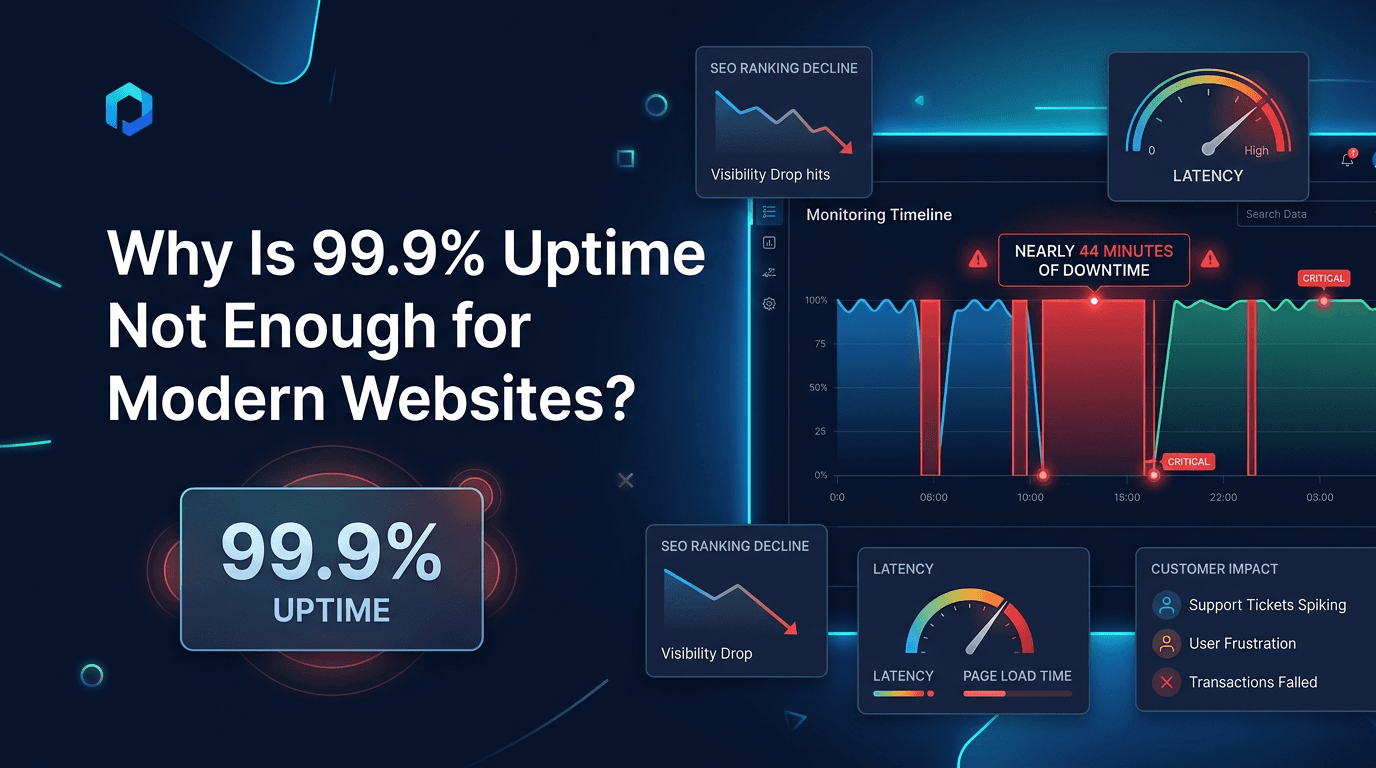
At first glance, 99.9% uptime sounds excellent. It looks close to perfect, and many teams still treat it as a strong reliability target. But for modern websites, especially SaaS platforms, ecommerce stores, and high-traffic content sites, 99.9% uptime is often far less impressive than it appears.
The reason is simple: 99.9% uptime still allows meaningful downtime. Over a full year, that is roughly 8.76 hours of unavailability. Even over a month, it allows about 43.8 minutes. For a modern business that depends on signups, logins, search visibility, support continuity, and customer trust, that amount of downtime can be far too expensive. In 2026, the standard for acceptable availability has changed because websites are no longer simple brochure pages. They are revenue systems, product interfaces, and growth engines.
What 99.9% Uptime Actually Means
Uptime percentages are easy to misunderstand because the number looks abstract. But once converted into real time, the picture becomes much clearer.
A 99.9% uptime target allows approximately:
- 8.76 hours of downtime per year
- 43.8 minutes of downtime per month
- 10.1 minutes of downtime per week
That may sound manageable until you apply it to real business scenarios. A 40-minute outage during a campaign launch, checkout surge, or weekday traffic peak can be extremely costly. Even if the annual uptime target is technically met, the operational and commercial damage can still be serious.
This is the core problem with relying on "three nines" as a comfort metric. It measures how much failure is tolerated, not how painful that failure becomes when it happens at the wrong time.
Modern Websites Fail in More Expensive Ways
Years ago, a website outage often meant the homepage would not load. Today, websites are much more complex. They rely on APIs, CDNs, DNS providers, authentication systems, third-party scripts, background jobs, payment processors, asset pipelines, and regional delivery infrastructure.
That means downtime is no longer just a server problem. A site can be functionally down in many ways while still looking partially available.
Examples include:
- the homepage loads but login fails
- the app shell loads but dashboard data times out
- checkout is broken while product pages remain online
- the site works in one region but fails in another
- pages return
200 OKwhile rendering an error state - SSL or DNS issues block access even though the origin is healthy
In all of these cases, the business still experiences downtime from the user's perspective. That is one reason 99.9% is often not enough. The real experience of failure is broader than the basic uptime number suggests.
Customers Expect Near-Continuous Availability
User tolerance for downtime has dropped sharply. People compare every digital experience to the most reliable services they use daily. If a website or SaaS product becomes unavailable, even briefly, users may abandon the task immediately and try a competitor instead.
This matters especially for:
SaaS Platforms
If customers cannot log in, access dashboards, or use key workflows, trust drops quickly. Repeated reliability issues create churn risk even when the total downtime percentage still looks acceptable.
Ecommerce Websites
A few minutes of checkout or payment failure can mean immediate revenue loss. During promotions or seasonal traffic spikes, the cost of downtime increases dramatically.
Lead Generation Sites
If high-intent landing pages fail during ad campaigns or organic traffic peaks, every minute of downtime wastes acquisition spend and reduces pipeline.
Content and Media Sites
If key articles, templates, or ad-supported pages are unstable, traffic and impressions drop even when the issue is short-lived.
For these businesses, the practical question is not whether 99.9% sounds good in a dashboard. It is whether the website can afford the amount of downtime that target permits.
99.9% Can Still Hurt SEO
Search engines do not evaluate uptime as a single marketing percentage. They experience your site as a crawler does: page by page, request by request, over time. If Googlebot encounters repeated errors, timeouts, or unstable behavior, that can affect crawl efficiency and trust.
A short isolated outage may not cause measurable ranking loss. But repeated downtime or poorly timed incidents can still create SEO problems, especially when they affect:
- high-ranking landing pages
- category or product templates
- blog templates
- documentation hubs
- localized or international pages
- newly published pages that need crawling
This is why 99.9% can be misleading from an SEO perspective. A site might technically remain within its uptime target while still creating repeated crawl friction across important URLs. Search visibility depends on consistency, not just a monthly percentage that looks acceptable in a report.
Timing Matters More Than Averages
One of the biggest weaknesses of a 99.9% uptime target is that it hides when downtime happens.
Forty minutes of downtime at 3:00 AM local time is very different from forty minutes of downtime during a major product announcement, Black Friday sale, or peak weekday traffic window. The same uptime percentage can produce radically different business outcomes depending on timing.
That is why modern reliability teams care about more than average uptime. They also care about:
- incident frequency
- incident duration
- time to detection
- time to resolution
- affected user flows
- affected regions
- whether critical pages were impacted
A site that goes down once for 40 minutes is different from a site that fails for four minutes every few days. Both may still fit inside a three-nines target, but the operational pattern and user trust impact are not the same.
99.9% Does Not Leave Much Room for Slow Recovery
Three nines sounds forgiving until you realize how little room there is for repeated mistakes. A few medium-sized incidents can consume the entire budget quickly.
That becomes a problem when teams have:
- slow monitoring intervals
- noisy alerting
- unclear ownership
- manual rollback processes
- weak incident runbooks
- incomplete monitoring coverage
In practice, teams that aim for 99.9% often discover they do not actually have much operational slack. A certificate issue, one deployment mistake, one DNS incident, and one third-party outage can consume the year's downtime allowance much faster than expected.
For a modern website, that is not a comfortable margin.
Why 99.99% Is Closer to the Real Baseline
For many modern websites, 99.99% uptime is a more realistic reliability target. That level allows roughly:
- 52.6 minutes of downtime per year
- 4.38 minutes of downtime per month
This is a very different standard. It forces better monitoring, faster response, and stronger infrastructure discipline. More importantly, it is much closer to the level of reliability users now expect from products they use regularly.
That does not mean every site needs five nines or extreme fault tolerance. But for SaaS products, high-conversion websites, and businesses with international traffic or strong SEO dependency, three nines is often too loose to reflect real business risk.
Why 99.9% Fails as a Strategic Goal
The deeper issue is not only the number itself. It is how teams use it.
When 99.9% becomes the headline goal, teams often optimize for passing the percentage instead of protecting the user experience. That leads to weak monitoring and incomplete visibility. A team may technically hit its uptime target while still missing serious user pain.
Common examples include:
Monitoring Only the Homepage
The homepage stays green while login, billing, or checkout is broken.
Ignoring Partial Failures
A region-specific CDN issue or auth failure does not count as "down" in the primary uptime report.
Using Plain HTTP Checks
A page returns 200 OK but serves broken or empty content.
Looking Only at Monthly Reports
The monthly number looks fine, but short recurring outages have already damaged trust and productivity.
This is why modern teams need reliability goals that reflect the business, not just a simple percentage.
What Teams Should Track Instead of Only Three Nines
A stronger approach is to pair uptime targets with metrics that reveal actual service quality.
The most useful metrics usually include:
- availability percentage
- p95 and p99 response time
- error rate
- time to detection
- MTTR
- regional availability
- critical flow coverage
- SSL and DNS dependency health
These metrics help teams understand whether the website is not only online, but actually usable, fast, and reliable in the places and workflows that matter.
How to Make 99.9% Less Dangerous
If a business is currently operating around a 99.9% target, the answer is not only to demand a better SLA overnight. The better move is to reduce how risky that downtime becomes.
Monitor Critical Paths Directly
Do not rely on a single root-domain check. Monitor login, signup, billing, dashboard entry, checkout, search, and top SEO landing pages.
Detect Regional Issues Early
Use multi-location monitoring so that partial outages do not hide behind one successful check.
Track Performance Degradation
Many incidents begin as latency problems before becoming full outages. Monitoring p95 and p99 can catch those earlier.
Improve Detection and Escalation
Shorter check intervals, confirmation logic, and cleaner alert routing reduce how long incidents remain invisible.
Protect Dependencies
DNS, SSL, CDN, and third-party integrations can all make a site effectively unavailable even when the origin is still healthy.
Review Incident Patterns
A reliability target is only useful if incident history is reviewed and recurring causes are removed.
Final Thoughts
99.9% uptime is not enough for many modern websites because it still allows too much downtime for systems that drive revenue, product access, search visibility, and customer trust. In a simpler web era, three nines may have felt strong. Today, it often hides more risk than teams realize.
Modern websites are complex, user expectations are higher, and failure is more expensive. A site can remain technically inside a 99.9% target while still creating repeated user frustration, SEO instability, and operational stress. That is why serious teams increasingly think beyond a single uptime percentage and focus on the actual experience users depend on.
If reliability matters to the business, the goal should not be to make 99.9% sound acceptable. The goal should be to understand what level of downtime the website can truly afford and build monitoring, recovery, and resilience around that reality.