


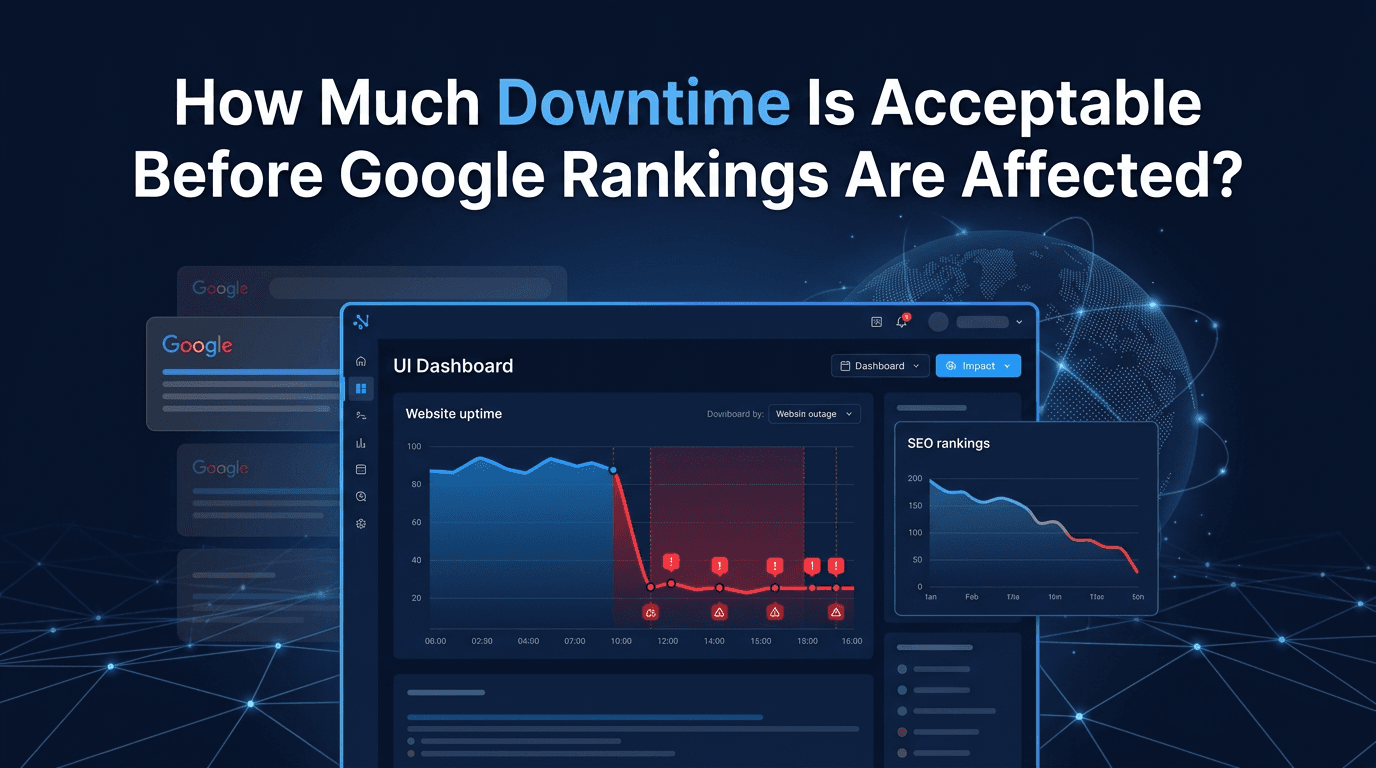
One of the most common SEO questions infrastructure and growth teams ask is simple: how much downtime is acceptable before Google rankings are affected? The honest answer is that there is no universal safe threshold. Google does not publish a fixed rule such as "30 minutes is fine" or "2 hours causes ranking loss." Instead, the impact depends on how long the outage lasts, how often it happens, which pages are affected, and whether Googlebot encounters the failure during important crawl windows.
That uncertainty is exactly why downtime should be treated seriously. A short, rare outage may have little long-term impact. But repeated failures, multi-hour incidents, and outages affecting critical templates can weaken crawl reliability, delay indexing, and contribute to ranking instability over time. In 2026, the better question is not just how much downtime is acceptable. It is how much downtime your SEO strategy can afford before trust, traffic, and conversions start slipping.
The Short Answer
Small, infrequent outages are unlikely to cause immediate ranking damage. But repeated downtime or longer unplanned incidents can absolutely affect SEO performance.
As a practical rule:
A Few Minutes of Rare Downtime
This usually creates little or no measurable SEO impact, especially if the issue is isolated and resolved quickly. Websites experience minor network issues from time to time, and search engines generally tolerate brief interruptions.
Repeated Short Outages
Even if each outage is brief, repeated failures create a pattern of unreliability. That pattern matters more than teams often realize because Googlebot may repeatedly encounter unstable behavior over time.
Outages Lasting Several Hours
Once downtime stretches into multiple hours, the risk rises significantly. Important pages may miss crawl windows, return repeated 5xx errors, or fail to serve content consistently. This can affect discovery, refresh cycles, and overall trust.
Multi-Day Downtime
Extended outages create the highest SEO risk. At that point, crawl disruption becomes severe, index freshness suffers, and some pages may lose visibility until Google can access them reliably again.
Why Google Rankings Are Affected by Downtime
Google rankings are influenced by many factors, but accessibility is a basic requirement. If Google cannot reach your content, it cannot crawl, evaluate, or confidently keep that content visible in search.
Downtime affects rankings through several connected mechanisms.
Googlebot Encounters Server Errors
When a site goes down, Googlebot may receive 5xx server errors, connection failures, or timeouts. Those responses tell Google that the page is temporarily unavailable. If the issue happens once, the impact may be limited. If it happens repeatedly, Google may reduce crawl activity or delay revisiting those URLs.
Crawl Budget Is Used Inefficiently
For large websites especially, crawl efficiency matters. If Googlebot spends requests on pages that fail, redirect poorly, or time out, that reduces the efficiency of the crawl process. Important new pages or updates may be discovered more slowly.
Index Confidence Can Drop
Search engines want to show reliable results. A page that is frequently unavailable is harder to trust than one that loads consistently. Even if the page content is strong, repeated technical instability can weaken confidence in its reliability.
User Experience Gets Worse
SEO is not only about bots. If real users click a result and hit an error page, they leave immediately. That damages brand trust, wastes acquisition traffic, and often sends users to competing results instead.
The Real SEO Risk Is Pattern, Not Just Duration
Many teams focus only on the length of a single outage. But from an SEO perspective, the pattern often matters more.
A site that is down once for ten minutes is different from a site that goes down for three minutes every day. Repeated instability can interfere with crawl consistency and create a weaker reliability profile overall. This is especially important for sites with:
- frequent content updates
- large URL inventories
- international traffic
- dependency-heavy templates
- ecommerce or lead-generation pages
- heavy use of JavaScript or third-party services
In these environments, small outages are rarely isolated. They tend to signal broader reliability problems that search engines and users will eventually notice.
Which Pages Are Most Sensitive to Downtime?
Not all downtime carries equal SEO risk. The effect depends heavily on which pages are affected.
High-Traffic Landing Pages
If pages that drive a large share of organic traffic go down, the impact can be immediate. These pages are often crawled more frequently and contribute directly to visibility and revenue.
Product and Category Pages
For ecommerce sites, these pages are core SEO assets. If they become unavailable during active crawl periods or shopping campaigns, both rankings and revenue can suffer.
Documentation and Programmatic SEO Pages
SaaS and technical sites often depend on large libraries of informational pages. Repeated instability across templates can affect crawl efficiency across the whole section.
Newly Published Content
Fresh content often depends on timely crawling to gain visibility. If new pages are inaccessible during initial discovery, indexing and ranking momentum may slow down.
When Does Downtime Become Dangerous?
There is no exact public Google threshold, but operationally, downtime becomes dangerous when any of the following are true:
Googlebot Encounters Repeated Errors
If the crawler repeatedly finds the same host or page unavailable, SEO risk rises quickly.
The Incident Affects Business-Critical Templates
An outage on one low-value page is very different from an outage across product pages, blog templates, or localized landing pages.
The Outage Happens During Peak Crawl or Traffic Periods
Timing matters. A failure during a major content launch, search spike, or campaign period can create outsized consequences.
Recovery Is Slow or Incomplete
Sometimes the site comes back, but performance remains unstable, pages return mixed responses, or content validation still fails. Partial recovery can still damage search performance.
What Google Is Likely to Tolerate
Google generally understands that temporary technical issues happen. Brief outages, maintenance events, and short-lived infrastructure incidents are part of operating websites at scale. The problem begins when downtime stops looking temporary and starts looking structural.
That means Google is more likely to tolerate:
- rare short outages
- planned maintenance handled cleanly
- isolated incidents with fast recovery
- small failures that do not affect core site sections
Google is less likely to tolerate:
- repeated
5xxerrors - slow recovery after major outages
- chronic instability across templates
- widespread crawl failures across many pages
- unreliable infrastructure that keeps resurfacing
How to Reduce Ranking Risk During Downtime
The best approach is not trying to guess the perfect safe number of minutes. It is reducing both outage frequency and outage impact.
Monitor Public Availability Continuously
External uptime monitoring helps teams detect issues before they become long enough to affect crawling or users at scale. Monitoring should include not only the homepage but also SEO-critical templates and top landing pages.
Watch for Performance Degradation Before Full Failure
Many outages begin as slowdowns. Rising response times, unstable Time to First Byte, or dependency failures can all be early warnings. If you detect those early, you may avoid a full crawl-blocking incident.
Protect SEO-Critical URLs Separately
Pages that drive organic traffic should be monitored intentionally. Category pages, content hubs, documentation, product templates, and location pages should not depend on a single homepage check.
Use Multi-Region Confirmation
A site can fail in one region and remain healthy in another. Multi-region checks help identify whether the issue is global, regional, DNS-related, or caused by CDN behavior.
Review Search Console After Major Incidents
After a serious outage, review crawl errors, indexing signals, and affected URLs in Google Search Console. This helps teams confirm whether the issue created visible crawl disruption.
Do Not Ignore Repeat Failures
One incident may be survivable. A pattern of recurring instability is much more dangerous. If the same issue keeps returning, it becomes an SEO risk even if each outage seems small by itself.
Common Misconceptions About Downtime and SEO
One misconception is that rankings only drop after very long outages. In reality, repeated shorter incidents can still create problems.
Another misconception is that if users can still access the homepage, SEO is safe. That is not true when important templates, APIs, or regional delivery paths are failing underneath.
A third misconception is that uptime percentage tells the whole story. It does not. A site can have an acceptable-looking monthly uptime figure while still creating unstable crawl and user experiences at critical moments.
Final Answer: How Much Downtime Is Acceptable?
A few rare minutes of downtime are unlikely to hurt rankings on their own. But there is no fixed amount of acceptable downtime that guarantees SEO safety. Once downtime becomes repeated, multi-hour, template-level, or badly timed, ranking risk increases fast.
The safest approach is to assume that every public outage matters. Not because every outage causes an immediate SEO penalty, but because reliability is cumulative. Search engines, users, and revenue systems all perform better when the site is consistently available.
In practical terms, the goal should not be to stay under a guessed Google threshold. The goal should be to minimize downtime, detect incidents quickly, protect critical pages, and recover before instability becomes a pattern. That is the point where uptime stops being only an infrastructure metric and becomes part of long-term SEO performance.
If your business depends on search visibility, the best amount of downtime is simple: as close to zero as possible.