


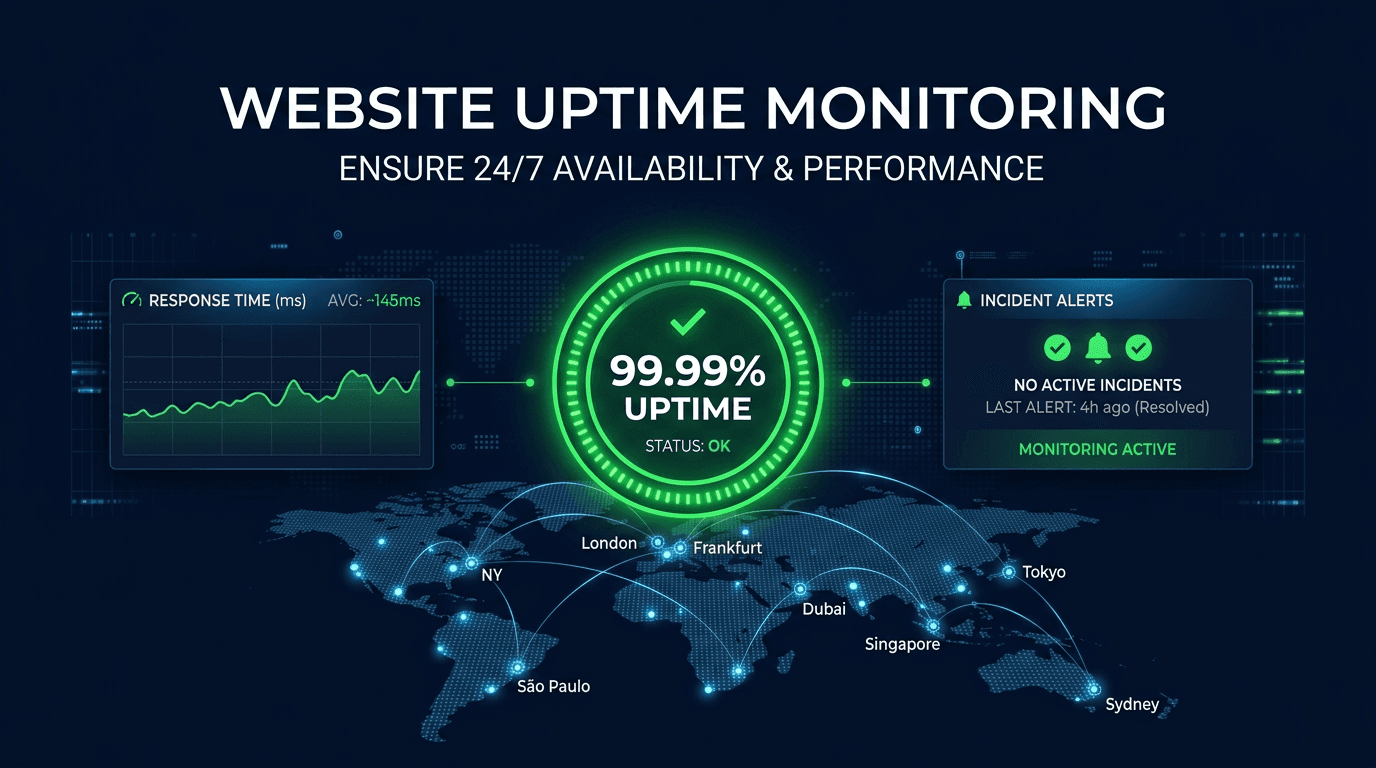
Website uptime monitoring is the practice of continuously checking whether a website is available, responsive, and functioning correctly from the perspective of real users. When a website goes down, becomes unreachable, or starts failing in key regions, monitoring systems detect the issue and send alerts so teams can respond before the damage spreads.
This matters for far more than infrastructure health. In 2026, uptime directly affects revenue, customer trust, paid campaign efficiency, and search visibility. If users cannot access a site, search engines cannot reliably crawl it either. That is why website uptime monitoring has become part of both operations and SEO strategy, not just a backend concern.
What Is Website Uptime Monitoring?
Website uptime monitoring is an automated process that checks whether a website or application is online at regular intervals. These checks are usually performed from external locations so teams can see whether the site is truly reachable on the public internet, not just whether a server appears healthy internally.
A monitoring system can test several things at once: whether the page responds, how long it takes to load, whether SSL is valid, whether DNS resolves correctly, and whether expected content is actually present. If something fails, the system records the event and alerts the responsible team.
At its simplest, uptime monitoring answers one question: can users reach the website right now? But modern monitoring goes further. It helps teams understand whether the issue is global or regional, brief or ongoing, isolated or part of a larger degradation pattern.
How Website Uptime Monitoring Works
Most uptime monitoring platforms run scheduled checks every 30 seconds, 60 seconds, or at other defined intervals. These checks usually come from multiple geographic locations to confirm whether a failure is real or just local network noise.
A typical workflow looks like this:
External Check Execution
The monitoring platform sends a request to the website from one or more locations. That request can be an HTTP or HTTPS check, a ping, a port check, or a content validation check.
Response Validation
The system evaluates the response. It checks whether the site returned the correct status code, whether the response time stayed within expected thresholds, and whether the page contains the expected content.
Failure Confirmation
To avoid false positives, many platforms require multiple failed checks or confirmation from more than one region before triggering a critical incident alert.
Alerting and Escalation
If the issue is confirmed, alerts are sent through channels such as email, Slack, SMS, PagerDuty, Discord, Teams, or webhooks. Some systems also apply escalation rules if the incident is not acknowledged in time.
Reporting and Trend Analysis
Once the issue is resolved, the monitoring platform keeps the incident history, uptime percentages, response time trends, and SLA-related metrics for later analysis.
Why Uptime Monitoring Matters for SEO
Website uptime matters for SEO because search engines need consistent access to your pages in order to crawl, index, and rank them properly. If your site becomes unavailable during crawl attempts, search engines may encounter timeouts, server errors, or unstable behavior that reduces confidence in the site.
A single brief outage may not create lasting damage, but repeated downtime or longer incidents can affect search performance in several ways.
Crawlability Suffers During Downtime
Search engines cannot crawl pages that return 5xx errors, time out, or become unreachable. If important pages are offline during crawl windows, new updates may not be discovered and existing pages may be crawled less efficiently.
Index Stability Can Weaken
If search engines repeatedly fail to access a page or domain, they may reduce crawl frequency or treat the site as less reliable. This becomes more serious when the same issue affects high-value landing pages, documentation, product pages, or content hubs.
User Experience Signals Get Worse
Downtime creates an immediate negative experience. Users bounce, abandon sessions, and often switch to a competitor. While not every outage creates a direct algorithmic penalty, poor reliability weakens the overall quality signals surrounding the site.
High-Value SEO Pages Become Risk Points
A website is rarely judged only by its homepage. If category pages, long-tail blog posts, local landing pages, or conversion-focused pages go down, the business impact can be much larger than the incident appears at first glance.
Why 99.9% Uptime Can Still Be Misleading
A lot of companies talk about uptime as a percentage, but percentages alone hide operational reality. A site can look healthy on a monthly dashboard while still creating painful user experiences through short but repeated outages.
For example, 99.9% uptime still allows measurable downtime over the course of a year. More importantly, it does not show when the failures happened, which pages were affected, whether they occurred in one region or globally, or whether they hit critical traffic windows.
From an SEO and revenue perspective, timing matters. A site going down during a major crawl period, product launch, or paid campaign can do outsized damage even if the monthly uptime number still looks acceptable.
What Should a Good Uptime Monitoring Setup Track?
A modern uptime strategy should monitor more than basic availability.
Availability Percentage
This shows how often the website was accessible over a defined time period. It is useful for SLA reporting and trend tracking, but it should never be the only metric.
Response Time
A website can be technically online but operationally unhealthy if performance has degraded badly. Monitoring latency helps teams catch issues before they become full outages.
Time to Detection and Time to Resolution
These metrics show how quickly incidents are noticed and fixed. In practice, detection speed often makes the difference between a minor disruption and a visible business incident.
Content Integrity
A page returning 200 OK does not always mean it is working correctly. Content checks validate that the expected text or elements are present.
Regional Availability
Global websites can fail in one geography while working elsewhere. Regional visibility is essential for both international SEO and customer experience.
SSL and DNS Dependencies
A healthy origin server does not help if the SSL certificate is expired or DNS is broken. Uptime monitoring works best when combined with SSL and domain monitoring.
Best Practices for Website Uptime Monitoring
The strongest monitoring programs are designed around real business risk, not just technical convenience.
Monitor Critical URLs, Not Just the Homepage
The homepage is rarely the only page that matters. Monitor login, signup, checkout, pricing, product, search, and top SEO landing pages separately.
Use Multi-Region Confirmation
Regional checks help identify whether an issue is global, CDN-related, DNS-related, or limited to a specific market. This improves both detection quality and incident triage.
Set Fast but Sensible Check Intervals
High-value public pages often justify 30 to 60 second checks. Less critical pages can use slower intervals. Detection speed should reflect business importance.
Validate Content, Not Only Status Codes
Content validation catches broken templates, empty states, and application-level failures that simple HTTP checks can miss.
Build Clear Alert Ownership
Alerts should reach the correct owner immediately. If a check has no clear escalation path, monitoring becomes observation instead of action.
Review Incident History Regularly
Historical uptime data reveals patterns. Teams often discover that the real problem is not one big outage but the same repeated failure mode across releases, regions, or dependencies.
Common Mistakes That Hurt SEO and Reliability
Many teams implement monitoring but still leave major gaps.
One common mistake is monitoring only the homepage. Another is relying only on internal dashboards rather than external checks. Some teams alert on every single failed probe, which creates noise and eventually trains people to ignore alerts. Others forget that SSL expiry, DNS drift, or third-party outages can make a site effectively unavailable even when the main server is still running.
There is also a strategic mistake: treating uptime as an infrastructure-only concern. In reality, uptime affects growth, SEO, paid acquisition, customer support, and brand reputation. The most effective teams treat website reliability as a cross-functional business priority.
How Uptime Monitoring Supports Long-Term Growth
Reliable uptime protects more than search rankings. It protects the entire customer journey. Organic traffic keeps flowing, paid campaigns do not send users into broken pages, support teams deal with fewer incident-related tickets, and engineers get better incident visibility.
For SEO specifically, uptime monitoring helps protect crawl consistency, template availability, and page trustworthiness. It gives teams earlier warning when technical issues threaten search visibility and helps reduce the risk of losing traffic to avoidable downtime.
That makes uptime monitoring a growth tool as much as a technical safeguard.
Final Thoughts
Website uptime monitoring is the practice of automatically checking whether your site is accessible, fast enough, and functioning correctly from real-world locations. It matters for SEO because search engines need reliable access to pages, and users expect a website to work every time they visit.
In 2026, uptime monitoring should be treated as part of the operating system of a serious website. It protects organic performance, reduces incident response time, improves customer trust, and gives teams a clearer view of what users actually experience. The goal is not only to know when a site goes down. The goal is to build a website that stays trustworthy, crawlable, and available as the business grows.
If you want stronger SEO performance and fewer unexpected incidents, uptime monitoring is one of the most practical foundations you can put in place.