


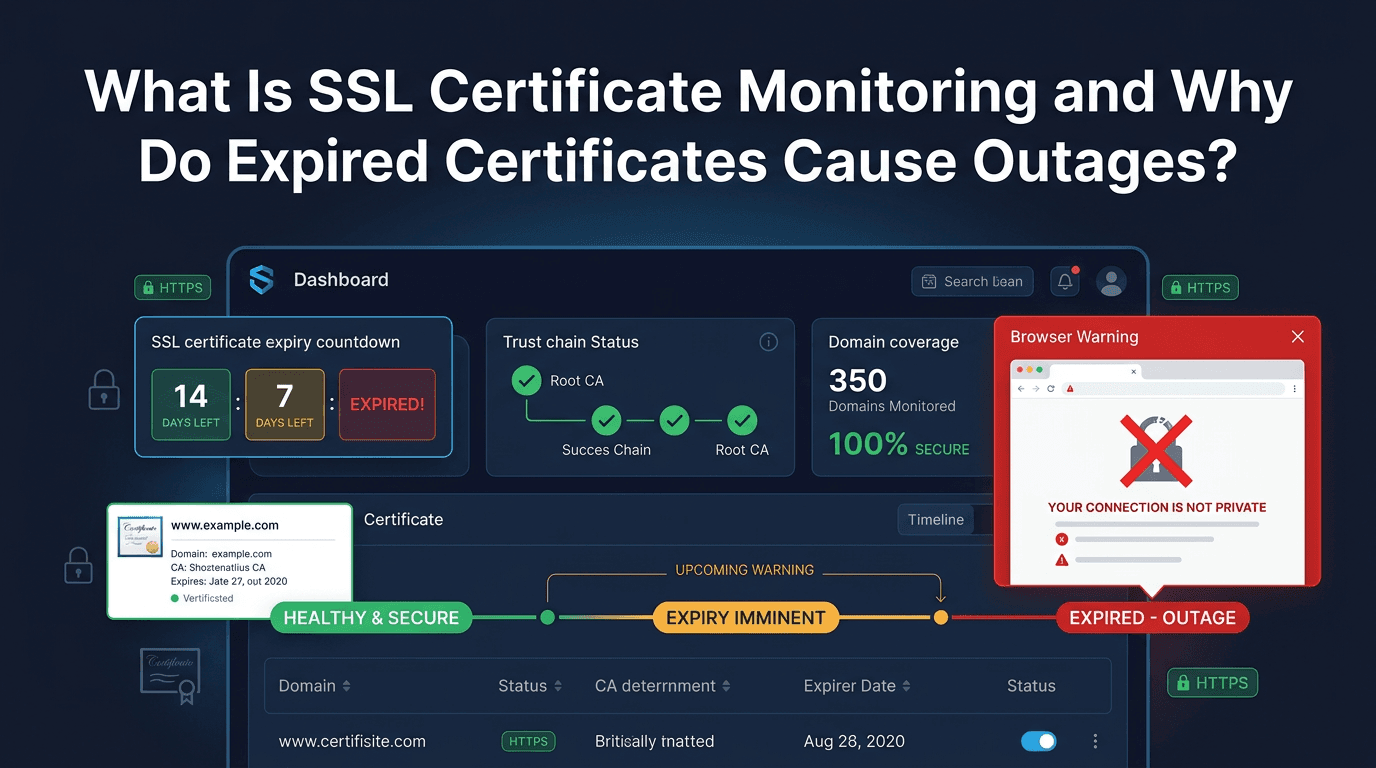
SSL certificate monitoring is the practice of continuously checking whether your SSL or TLS certificates are valid, correctly deployed, trusted by browsers, and approaching expiration. It exists because HTTPS is now a basic requirement for trust, security, SEO, and product reliability. When a certificate expires or is misconfigured, the damage is immediate: users see security warnings, browsers block access, APIs fail to connect, and business-critical flows stop working even if the server itself is healthy.
That is why certificate monitoring is not just a security task. In 2026, it is an uptime and trust discipline. Modern websites depend on HTTPS at every layer — from landing pages and login forms to payment flows, API requests, and mobile app connections. If certificate health breaks, the website may still be online from an infrastructure perspective, but it becomes effectively unavailable to real users.
What Is SSL Certificate Monitoring?
SSL certificate monitoring is the ongoing process of tracking the operational health of the certificates that secure your domains, subdomains, APIs, and related services. A monitoring system checks whether certificates are still valid, how long they have before expiration, whether the correct domains are covered, whether the full chain of trust is intact, and whether real endpoints are serving the expected certificate.
In practice, this means monitoring does more than count down to expiry. It also helps answer questions like:
- Is the certificate close to expiring?
- Is the full chain trusted by all major browsers?
- Does the certificate still cover the required domains and subdomains?
- Was the renewed certificate actually deployed to production?
- Are all regions and edge nodes serving the same valid certificate?
Without this visibility, teams often discover certificate problems only after customers are already blocked.
Why HTTPS Certificate Health Matters So Much
HTTPS is no longer optional for serious websites. Users expect it, browsers enforce it, search engines prefer it, and many product workflows depend on it silently in the background.
When certificate health is strong, users never think about it. Pages load normally, data is encrypted, APIs connect securely, and trust stays invisible but intact. When certificate health fails, the opposite happens instantly. Trust breaks in public, often with very little warning.
That makes SSL monitoring unusually important compared to other infrastructure checks. Many infrastructure issues degrade gradually — slower response times, intermittent errors, partial failures. Certificate issues often create a hard stop: everything works, then nothing works, with no middle ground.
Why Expired Certificates Cause Real Outages
An expired certificate causes an outage because browsers, apps, and integrations can no longer trust the connection they are being asked to use. Even if the server is responding perfectly, the client cannot safely establish a secure session.
From a technical perspective, the service may still be "up." From a user perspective, it is effectively down.
Browsers Show Blocking Security Warnings
When a certificate expires, browsers display strong warnings such as "Your connection is not private" or similar full-page trust errors. Most users do not proceed past this screen. Many never even try. For public websites, that means traffic, conversions, and trust can disappear immediately.
Google Chrome, Safari, Firefox, and Edge all display these warnings differently, but none of them allow silent bypass by default. The user must actively click through multiple warnings to reach the site, and most will not.
APIs and Webhooks Fail Secure Connections
Expired certificates do not only affect browser traffic. API clients, webhooks, internal service calls, and third-party integrations may reject the connection automatically. In modern systems, this can create cascading failures across checkout, authentication, notifications, and data syncs.
A single expired certificate on an API gateway can simultaneously break every downstream consumer that depends on it — partner integrations, mobile apps, CI/CD pipelines, and monitoring tools included.
Mobile Apps and Pinned Clients Can Break Completely
Some mobile apps and SDKs are strict about certificate trust or certificate pinning. When certificate expectations are no longer met, the app may stop working entirely or reject requests without giving the user a helpful explanation. The app simply appears "broken" with no visible cause.
Search Engines and Paid Traffic Still Hit the Broken Experience
If landing pages, product pages, or SEO-critical templates show certificate errors, search visibility and paid acquisition performance can suffer. The page may technically exist, but if users and crawlers cannot access it normally, it is operationally broken.
Google has confirmed that HTTPS is a ranking signal, and crawlers that encounter certificate errors will stop indexing the affected pages. Paid ad platforms may also pause campaigns that send users to certificate-warning pages.
Why Expired Certificates Feel So Sudden
One reason certificate incidents are so painful is that they often appear sudden from the outside. The site may work normally for months, then fail all at once when the certificate passes its validity window.
This creates a false sense of safety. Teams may think everything is fine because HTTPS has been stable for a long time, but the certificate lifecycle has been counting down in the background the entire time.
That is exactly why monitoring matters. Certificate risk is predictable, but only if someone — or something — is watching it continuously.
Why Auto-Renew Alone Is Not Enough
Many teams assume auto-renew solves the problem entirely. It helps significantly, but it does not eliminate risk. Certificate outages still happen regularly in organizations that have auto-renewal configured, because renewal is only one part of the lifecycle.
Auto-renew can fail for many reasons:
- DNS validation breaks due to record changes
- API credentials used by the renewal agent expire or rotate
- Port or routing assumptions change during infrastructure updates
- Renewal succeeds but deployment to the actual server fails
- One CDN edge node serves an outdated certificate while others are updated
- The new certificate has incomplete SAN coverage, missing a subdomain
In all of these cases, the certificate process may appear automated and healthy while real users are still at risk. Monitoring closes that gap by verifying the result from the outside — checking what browsers and clients actually see, not what the internal renewal system reports.
What SSL Certificate Monitoring Should Check
A strong monitoring setup should cover several dimensions beyond simple expiration tracking.
Expiration Date
This is still the most fundamental check. Teams should know well in advance when a certificate is approaching renewal time. Best practice is to use tiered alerts — 60, 30, 14, 7, and 1 day before expiry — creating multiple opportunities to catch and resolve issues before they affect users.
Certificate Chain Health
A valid leaf certificate can still fail if the intermediate chain is broken, outdated, or served incorrectly. Monitoring should verify the full trust path that clients actually receive, from the leaf certificate through intermediates up to the trusted root CA.
Domain and SAN Coverage
Certificates must cover the hostnames you serve. If a renewal drops a domain or subdomain from the certificate's Subject Alternative Names list, part of the environment may break even though the certificate itself is technically valid.
Live Deployment Verification
Monitoring should check the actual public endpoint, not just the certificate automation system. That confirms the renewed certificate reached the reverse proxy, CDN, ingress, or load balancer that customers use.
Regional or Edge Consistency
Distributed systems can serve different certificate states in different places. A certificate might be valid from your office but expired on a specific CDN edge node or in a particular region. Multi-location checks help catch regional mismatches and stale deployments.
Which Services Are Most at Risk From Certificate Expiration?
Any public or trust-sensitive service can be affected, but some environments feel the impact more immediately than others.
Ecommerce Sites
Checkout and payment flows depend on uninterrupted trust. If a certificate error appears during a transaction, customers leave and revenue stops instantly. PCI DSS compliance also requires encrypted connections for cardholder data, making certificate health a regulatory issue as well.
SaaS Products
Login pages, dashboards, tenant subdomains, and API endpoints all depend on HTTPS. One expired certificate can block access across the entire product or break key integrations that customers rely on.
Marketing and SEO Pages
A high-ranking page that begins showing browser warnings can lose traffic, trust, and conversion value quickly. Recovery from a Google de-indexing event caused by prolonged certificate errors can take weeks.
Internal APIs and Tools
Not every certificate incident is public-facing. Internal dashboards, CI/CD systems, observability tools, VPN endpoints, and admin interfaces can all fail due to certificate issues — often with no customer-visible symptoms until something downstream breaks.
Why Certificate Monitoring Matters More in 2026
The certificate landscape is becoming more operationally demanding. Starting in 2026, maximum certificate validity periods are shrinking from 398 days to 200 days, with further reductions to 47 days planned by March 2029. This means organizations will need to renew certificates approximately eight times per year instead of annually.
That means more renewal events, more chances for deployment drift, and more pressure on teams that still depend on manual reminders or incomplete certificate inventories. The shorter the lifecycle becomes, the less realistic manual certificate management gets.
SSL monitoring becomes the safety layer that keeps shorter lifecycles from turning into more frequent outages. It transforms certificate management from a periodic task into a continuous operational practice.
Best Practices for Preventing Certificate-Related Outages
The strongest teams treat certificates like production infrastructure, not like paperwork.
Use Layered Expiration Alerts
Alert at several stages — 60, 30, 14, 7, and 1 day before expiry. This creates time for planning, escalation, and recovery if renewal fails at any step.
Monitor Real Endpoints Externally
Check what browsers and clients actually receive, not just what the internal renewal job reports. External monitoring catches deployment failures that internal checks miss.
Validate the Full Chain
Do not stop at the visible server certificate. Chain errors — missing or expired intermediate certificates — are a common cause of production trust failures that are easy to overlook.
Track Ownership Clearly
Every important certificate should have a clear team or owner responsible for renewal and incident response. Ownership gaps are the number one reason certificate renewals are missed.
Include APIs, Subdomains, and Edge Infrastructure
The main website is not the whole environment. Monitor every endpoint where certificate trust matters operationally — API gateways, staging environments, internal tools, CDN edges, and customer-specific domains.
Common Mistakes to Avoid
One common mistake is assuming a valid certificate somewhere in the pipeline means the whole environment is safe. In distributed systems, one edge or host can still serve an outdated or broken certificate while everything else looks healthy.
Another mistake is relying entirely on calendar reminders. These fail when ownership changes, environments grow, or certificate validity windows shorten.
Teams also often monitor only the main domain and forget API hosts, app subdomains, staging systems, or customer-specific domains. These blind spots are where certificate incidents often begin.
Finally, many organizations test certificates only over IPv4 or from a single geographic location. Certificates can behave differently over IPv6, from different regions, or through different network paths.
How Is SSL Certificate Monitoring Different From Other Types of Monitoring?
SSL certificate monitoring focuses specifically on the trust layer that sits between your server and every client that connects to it. Unlike uptime monitoring, which checks whether a server responds, certificate monitoring verifies whether that response can be trusted. A server can be fully operational and still be inaccessible to users if the certificate is expired or misconfigured.
Can SSL Certificate Monitoring Help With Compliance?
Yes. Industries governed by PCI DSS, HIPAA, SOC 2, and similar frameworks require encrypted data transmission. Certificate monitoring provides continuous verification that encryption is active and correctly configured, creating the audit trail that compliance reviews require.
What Is the Difference Between SSL and TLS Certificate Monitoring?
Functionally, there is no difference for monitoring purposes. SSL is the older protocol name, and TLS is the current standard, but the certificates themselves are the same. "SSL monitoring" and "TLS monitoring" refer to the same operational practice of tracking certificate health.
How Often Should SSL Certificates Be Checked?
For production systems, certificates should be checked at least once per day, and ideally every few hours. The closer you get to expiration, the more frequently checks should run. Tiered alerting at multiple intervals before expiry is more effective than a single reminder.
What Happens If a Certificate Expires on a Weekend or Holiday?
The outage happens immediately regardless of timing. That is why automated monitoring with multi-channel alerting — email, SMS, Slack, PagerDuty — is essential. Relying on manual checks means weekends and holidays become the highest-risk periods for certificate incidents.
Final Thoughts
SSL certificate monitoring is the continuous process of checking whether your HTTPS certificates are valid, trusted, correctly deployed, and approaching expiration. It matters because expired certificates create real outages — not just security warnings. When trust fails, websites, APIs, apps, and customer flows become inaccessible immediately, even though the servers behind them are still running.
That is why expired certificates cause so much disruption. They do not just reduce security posture. They block normal access, damage confidence, interrupt integrations, and put revenue, SEO, and customer experience at risk all at once.
For modern teams operating in 2026 and beyond — where certificate lifecycles are getting shorter and infrastructure is more distributed than ever — certificate monitoring should be treated as part of core reliability. If your product depends on HTTPS, monitoring certificate health is one of the simplest and highest-value ways to prevent avoidable outages.