


SaaS teams often start monitoring with a simple goal: know when the website is down. That is a good first step, but it is not enough for a product that depends on reliability, renewals, user trust, and fast incident response. A SaaS website can remain technically online while critical experiences are already degraded. Login may be slow, dashboard pages may fail intermittently, or a regional outage may affect paying users without showing up as a full site failure.
That is why the first uptime metrics matter so much. Teams that track the right signals early can detect issues faster, reduce noise, and align monitoring with real customer experience. Teams that track the wrong ones often end up with dashboards full of numbers but very little operational clarity. In 2026, the best SaaS monitoring setups start with a focused set of metrics that reflect both service health and business impact.
Start With Metrics That Reflect User Experience
Not every available metric deserves equal priority. SaaS teams should begin with the indicators that answer the most important operational questions: is the site reachable, is it fast enough, are users hitting errors, and how quickly can the team recover when something breaks?
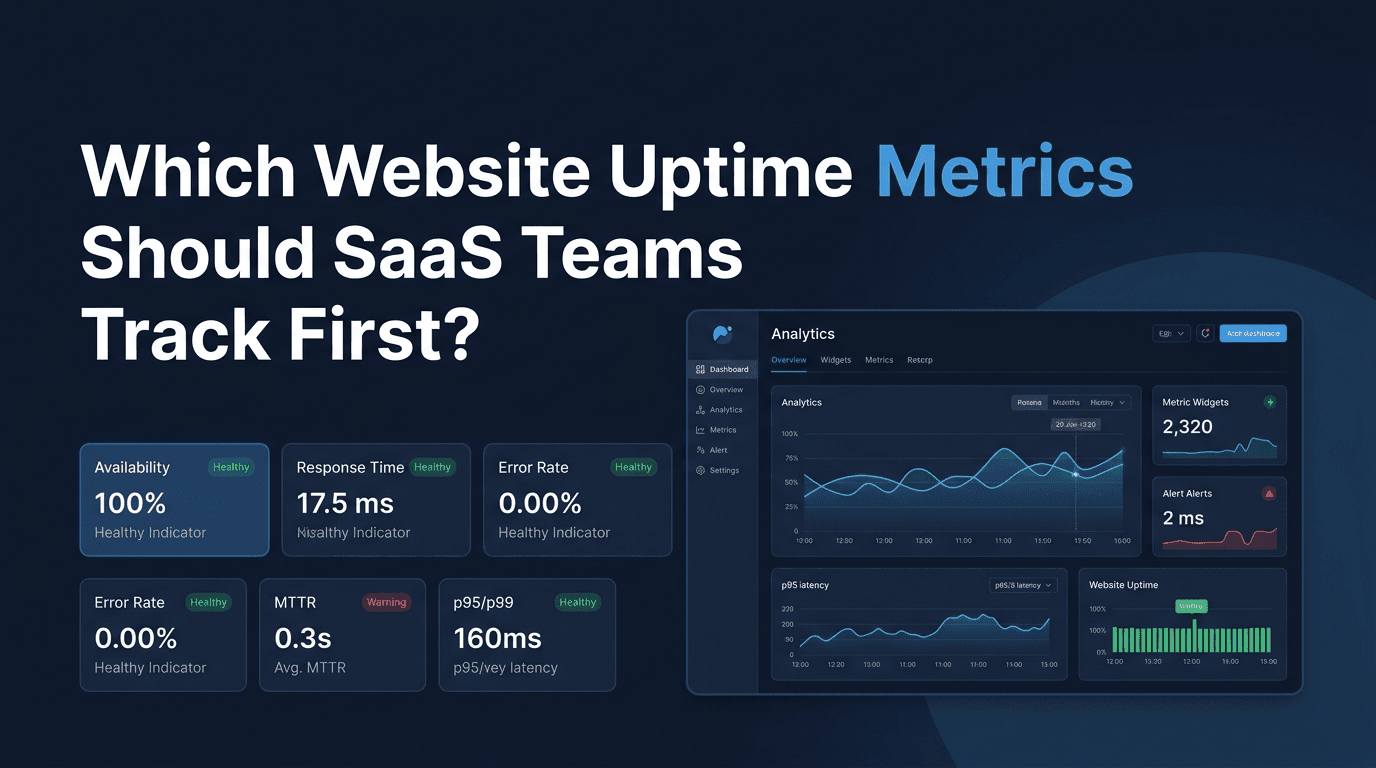
That usually means starting with five core metrics:
- availability
- response time
- error rate
- time to detection and time to resolution
- user-impact coverage across critical flows
These metrics create the foundation for uptime monitoring that is actually useful in production.
1. Availability Percentage
Availability is the most basic uptime metric, and it should always be one of the first things a SaaS team tracks. It shows the percentage of time the website or application is accessible over a defined period. This is the number most commonly associated with uptime targets and SLA reporting.
For SaaS teams, availability helps answer a simple but essential question: how often can customers actually reach the product? Whether your internal target is 99.9%, 99.95%, or 99.99%, availability gives you the baseline reliability picture.
That said, availability should not be treated as the whole story. A site can show strong uptime on paper while still creating poor user experiences through slow responses or intermittent failures. Availability is the first metric, not the only metric.
2. Response Time
If availability tells you whether the service is up, response time tells you how healthy it is while up. For SaaS applications, slow pages and delayed application behavior are often as damaging as outright downtime.
Track not only the average response time but also high-percentile latency, especially p95 and p99. These percentiles reveal the worst-performing requests that averages tend to hide. A stable average can still mask a poor experience for a meaningful share of users.
For public pages, login screens, and dashboard entry points, rising response time often appears before a full outage. That makes latency one of the best early-warning metrics a SaaS team can monitor.
3. Error Rate
Error rate measures how often requests fail relative to total traffic. This is one of the most important operational metrics because many incidents show up as partial failure rather than total outage.
A SaaS product may still be online while some requests return 5xx errors, some pages fail to render fully, or certain customer actions break under load. Error rate helps detect those degraded states before they become widespread support incidents.
The most useful approach is to focus on meaningful failures. Server-side 5xx errors are usually high priority. Depending on the product, certain 4xx spikes may also matter if they indicate broken redirects, invalid sessions, authentication loops, or routing problems.
4. Time to Detection
A reliability program is only as strong as its detection speed. Time to detection measures how long it takes for the team or monitoring system to notice that something is wrong.
This metric matters because even a short outage becomes more expensive when it is discovered too late. If a business-critical issue begins at 10:00 and nobody knows until 10:12, that is already a serious monitoring failure for many SaaS environments.
The goal is to shorten the gap between incident start and awareness. Fast check intervals, regional confirmation, and clean alert routing all improve this metric.
5. Mean Time to Resolution
Once a failure is detected, the next priority is recovery. Mean Time to Resolution, often shortened to MTTR, measures how long it takes to restore service after an incident begins or is detected.
MTTR matters because availability alone does not explain operational maturity. Two SaaS teams can experience the same number of incidents, but the one with faster resolution causes less user frustration, lower churn risk, and smaller revenue impact.
Tracking MTTR also improves post-incident learning. If recovery stays slow, the team can examine escalation paths, ownership gaps, runbooks, tooling quality, or noisy alerts that delayed action.
6. Critical Flow Coverage
One of the most overlooked early metrics is not a number on a graph but a coverage question: are you monitoring the flows that matter most?
For SaaS teams, homepage uptime is useful, but it is rarely enough. The product depends on specific user journeys such as login, signup, onboarding, dashboard load, billing, settings, and account recovery. If those flows break while the homepage remains healthy, the service is still failing users.
That is why teams should track uptime metrics across critical URLs and workflows, not just a root domain. Monitoring coverage is a strategic metric because blind spots create false confidence.
Which Metric Should Come First?
If a SaaS team is starting from scratch, availability and response time are usually the best first pair. Availability tells you whether the product is reachable. Response time tells you whether the reachable product is actually usable.
After that, error rate should come next because it catches degraded service states that uptime percentages miss. Then teams should add time to detection, MTTR, and broader critical-flow coverage so the monitoring system becomes operational rather than purely descriptive.
In practical order, most teams should prioritize:
- availability
- response time
- error rate
- time to detection
- MTTR
- critical flow monitoring coverage
This order gives the team the fastest path to meaningful visibility without overcomplicating the stack.
Why SaaS Teams Need More Than a Single Uptime Number
A single uptime percentage does not capture the complexity of a SaaS product. Customers interact with authentication systems, APIs, dashboards, billing flows, static assets, and regional delivery layers. A narrow uptime view misses too much.
For example, the marketing homepage may be available while authenticated dashboard requests are slow. The login page may load while session creation fails. A page may return 200 OK while showing an error state in the UI. These are the kinds of issues that create churn and support load even though the service appears "up" in a basic monitor.
That is why the first uptime metrics should always be interpreted together. Availability without latency can mislead. Latency without error rate can miss failure spikes. Detection without MTTR does not show whether the incident process is improving.
How These Metrics Support SLA and SLO Thinking
Even if a team is not formally running a full SLO program yet, these uptime metrics create the raw material for one. Availability and latency become service level indicators. Error rate helps quantify reliability breaches. MTTR shows whether incident handling is improving. Coverage across critical flows helps ensure the objectives reflect customer reality instead of dashboard convenience.
For SaaS businesses, this matters because reliability is not only technical. It affects renewals, product trust, sales confidence, and support cost. The earlier teams connect metrics to business outcomes, the more useful monitoring becomes.
Common Mistakes to Avoid
One common mistake is tracking only uptime percentage and assuming that is enough. Another is relying on averages while ignoring percentile latency. Teams also often monitor the homepage but forget the authenticated parts of the product where user value actually lives.
Another mistake is treating error rate as an API-only metric. Many website incidents in SaaS products begin as partial page or application failures that error metrics can reveal early. A final mistake is failing to measure operational response. If you do not track time to detection and MTTR, it is difficult to improve incident handling in a disciplined way.
A Practical Starter Dashboard for SaaS Teams
If you want a clean first dashboard, keep it focused. The starting view should show:
- current availability status
- 24-hour and 30-day uptime percentage
- p50, p95, and p99 response time
- rolling error rate
- open incidents and recent incident history
- average time to detection
- average MTTR
- status of login, signup, dashboard, and billing checks
That dashboard gives most SaaS teams enough signal to detect problems early and prioritize reliability work intelligently.
Final Thoughts
The first website uptime metrics SaaS teams should track are availability, response time, error rate, time to detection, MTTR, and coverage of critical product flows. Together, these metrics give a practical view of whether the product is reachable, usable, stable, and operationally manageable.
The key is not collecting the most metrics. It is starting with the ones that reveal real user pain and help the team act faster. When uptime monitoring is grounded in those signals, it becomes far more than a status check. It becomes a system for protecting trust, reducing churn risk, and improving product reliability over time.