


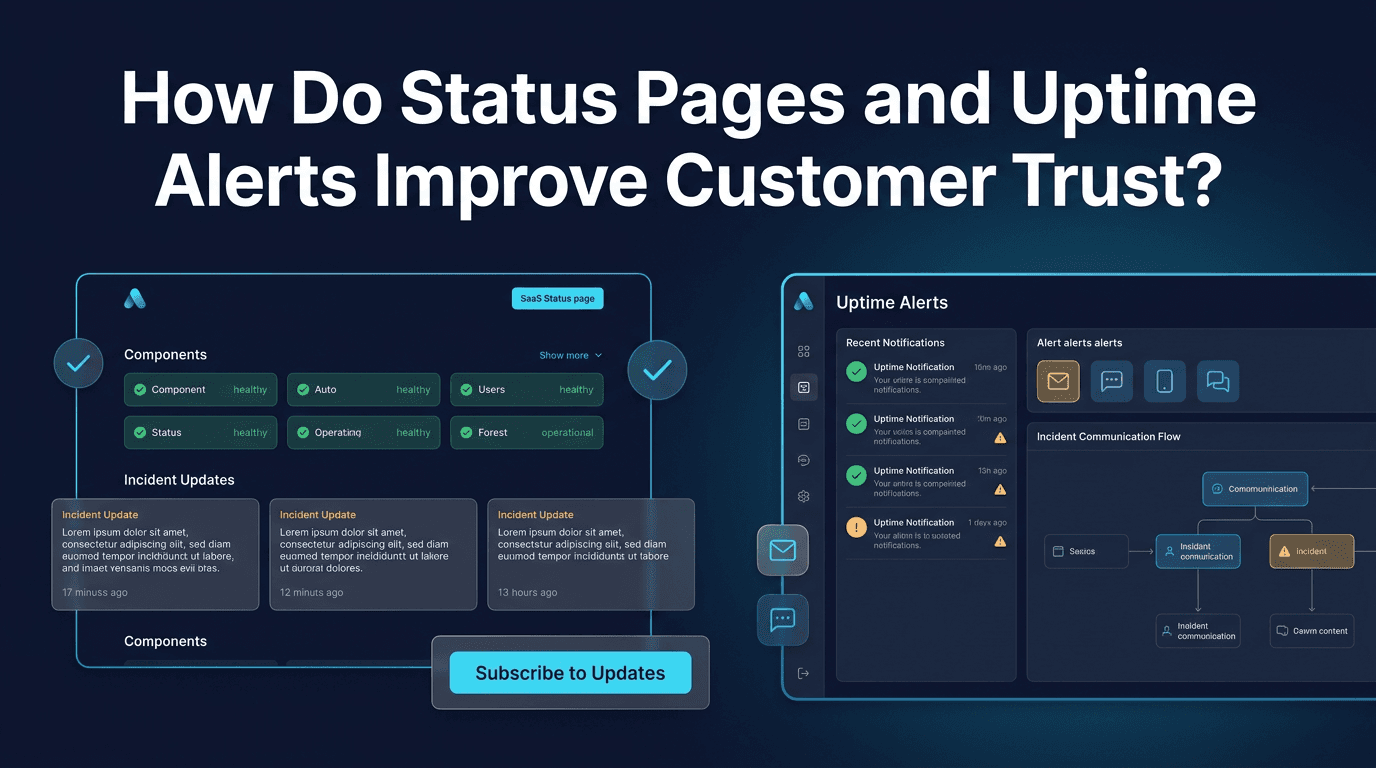
Customer trust is easy to damage and slow to rebuild. When a website or SaaS product has an outage, users rarely judge the company only by the technical failure itself. They also judge how clearly the business communicates, how quickly it acknowledges the issue, and whether customers feel informed or abandoned while the problem is being fixed.
That is why status pages and uptime alerts matter far beyond operations. In 2026, they are not just internal reliability tools. They are trust systems. A good status page reduces confusion, and a good alerting strategy helps teams respond quickly enough to communicate before frustration spreads. Together, they turn outages from silent failures into managed incidents with visible accountability.
Why Trust Drops So Fast During Downtime
When users cannot access a product, uncertainty becomes the first problem. They do not know whether the issue is local, account-specific, regional, or platform-wide. They do not know whether the company has noticed it. They do not know whether they should retry, wait, contact support, or escalate internally.
This uncertainty creates more frustration than many teams realize. A short outage with clear communication often feels more manageable than a smaller issue with no acknowledgment at all. Customers can tolerate problems more easily when they understand what is happening and believe the provider is handling it responsibly.
That is why trust during incidents depends on two things: operational awareness and communication quality. Status pages and uptime alerts support both.
What Status Pages Actually Do
A status page is a public-facing view of service health. It gives customers a clear place to check whether the platform is currently operational, which components are affected, and whether the team has already identified and acknowledged an issue.
A strong status page usually shows:
- current platform status
- affected components or services
- active incident updates
- maintenance announcements
- historical uptime or incident history
- subscription options for future updates
This matters because customers should not have to guess whether the problem is real. A status page gives them an authoritative source instead of forcing them to refresh dashboards, message support, or search social media for clues.
What Uptime Alerts Do Behind the Scenes
Status pages help externally, but they depend on something happening internally first. That is where uptime alerts come in.
Uptime alerts notify teams when the website, application, or key customer flows become unavailable or unhealthy. They reduce the delay between failure and awareness. Without alerting, teams often learn about incidents from angry users. With alerting, the company can acknowledge the issue first and communicate with control.
The trust benefit starts here. Customers trust companies more when the company already knows something is wrong and is actively responding. They trust companies less when they have to report the outage before the business notices.
Fast Acknowledgment Builds Confidence
One of the strongest ways status pages and alerts improve trust is by enabling fast acknowledgment. Customers do not expect every service to be perfect all the time. But they do expect transparency when something breaks.
If a monitoring system detects a real outage and the team publishes an incident notice within minutes, the message is clear: we see the issue, we are working on it, and you do not need to waste time proving that the problem exists. That alone can reduce frustration significantly.
Fast acknowledgment creates several trust advantages:
- customers know the issue is recognized
- support teams receive fewer repetitive tickets
- internal stakeholders get a clear source of truth
- rumors and confusion spread less quickly
- the provider appears organized instead of reactive
Silence, by contrast, often makes the outage feel worse than it is.
Transparency Reduces Customer Anxiety
During an incident, customers are not only waiting for resolution. They are also evaluating risk. They want to know whether data is affected, whether the issue is global, whether work is blocked, and how long disruption may last.
Status pages reduce this anxiety by making the situation visible. Even when the root cause is still being investigated, transparent updates help customers understand that progress is happening. This is especially important for business-critical tools where customer teams must make decisions quickly.
Transparency does not require overexplaining technical details. In fact, simple customer-friendly language is usually better. Instead of vague engineering jargon, strong updates explain the impact in terms users understand, such as login issues, delayed dashboard loading, or checkout failures.
Uptime Alerts Help Teams Communicate Before Support Is Overwhelmed
Support queues often become the first visible sign of weak incident communication. If the website is down and no public update exists, customers open tickets, message account managers, post in chat communities, and ask whether the issue is isolated. That creates operational noise at exactly the wrong moment.
Effective uptime alerting helps prevent that by shortening time to internal awareness. If the monitoring system triggers quickly and routes the alert to the right team, incident communication can begin before support volume spikes too far. That protects both customer experience and internal response quality.
This is one reason alert design matters. Alerts are not only about technical response. They also shape the timing and confidence of customer communication.
Separate Status Pages Create Credibility
A status page only builds trust if it remains available during incidents. If the main website is down and the status page is down too, the company loses one of its most important communication channels.
That is why the best status pages run on separate infrastructure and remain reachable even when the main application is failing. This separation increases credibility because customers can still access updates when they need them most.
It also signals maturity. A company that invests in independent incident communication looks more prepared than one that treats outage messaging as an afterthought.
Better Incident Updates Create Better Relationships
Not all status updates are equally useful. A good update tells customers what is affected, what the team is doing, and when to expect another update. It does not need to promise an exact resolution time too early. In fact, overconfident promises often damage trust more than honest uncertainty.
The best updates are:
- fast
- specific about impact
- plain in language
- consistent in cadence
- honest about what is known and unknown
When customers see this kind of communication repeatedly, it changes how they interpret future incidents. They may still be inconvenienced, but they are more likely to believe the provider is competent and accountable.
Historical Incident Visibility Strengthens Trust Over Time
A strong status page does not only show what is happening now. It also shows what has happened before. Historical uptime and incident records can increase trust because they demonstrate that the company is willing to be transparent over time, not only in isolated moments.
This kind of visibility is valuable for procurement, renewal conversations, technical due diligence, and enterprise customers evaluating vendor maturity. It signals that the business treats reliability as measurable and reportable, not just something hidden behind marketing claims.
For modern SaaS companies, this can become a competitive advantage. Customers increasingly prefer vendors that communicate clearly over vendors that appear polished only when everything works.
Status Pages and Alerts Also Improve Internal Trust
Customer trust is the obvious benefit, but internal trust matters too. Sales, support, success, and leadership teams all need a reliable source of truth during incidents. Without one, they create their own explanations, overpromise to customers, or escalate noise back into engineering.
Status pages and uptime alerts help align internal teams around the same reality. Everyone sees whether the issue is active, what is affected, and what has been communicated publicly. This reduces confusion and makes the company look more coordinated externally.
In practice, internal trust often shapes external trust. A business cannot communicate confidently to customers if internal teams are unsure what is happening.
Common Mistakes That Weaken Trust
One common mistake is waiting too long to post the first update. Teams sometimes want perfect certainty before publishing anything, but customers usually prefer quick acknowledgment over delayed precision.
Another mistake is posting vague messages with no impact detail, such as "we are investigating an issue." That is better than silence, but it still leaves customers guessing. It is stronger to say which features or user groups appear affected.
A third mistake is failing to update regularly. If the status page goes silent for too long, customers may assume the response is stalled. Consistent cadence matters even when there is little new information.
Teams also weaken trust when they use a status page as a branding page instead of a communication tool. During incidents, clarity matters more than design flourish.
What Good Trust-Building Incident Communication Looks Like
The strongest incident communication workflow usually looks like this:
- uptime monitoring detects a confirmed issue
- alerts reach the right internal owners quickly
- the team verifies scope and impact
- a status page update is published fast
- customers can subscribe to updates
- follow-up messages continue until resolution
- a final confirmation and retrospective may follow
This process creates a much better customer experience than waiting for social media complaints or support tickets to define the narrative.
Why This Matters for Modern SaaS and Online Businesses
For modern websites and SaaS products, trust is part of product value. Customers are not only buying features. They are buying reliability, accountability, and communication quality. When incidents happen, status pages and uptime alerts become visible proof of how the company operates under stress.
That is especially important for:
- SaaS products with business-critical workflows
- ecommerce stores handling transactions
- agencies managing client websites
- platforms serving international traffic
- vendors selling into enterprise accounts
In all of these cases, transparent incident communication can reduce churn risk and strengthen long-term credibility.
Final Thoughts
Status pages and uptime alerts improve customer trust by reducing uncertainty, increasing transparency, and helping companies communicate faster and more clearly during incidents. The technical outage may still be painful, but customers respond far better when they know the issue is acknowledged, understood, and actively managed.
That is why these tools matter beyond uptime itself. Uptime alerts help teams know first. Status pages help customers stay informed. Together, they transform incident communication from reactive damage control into a structured trust-building process.