


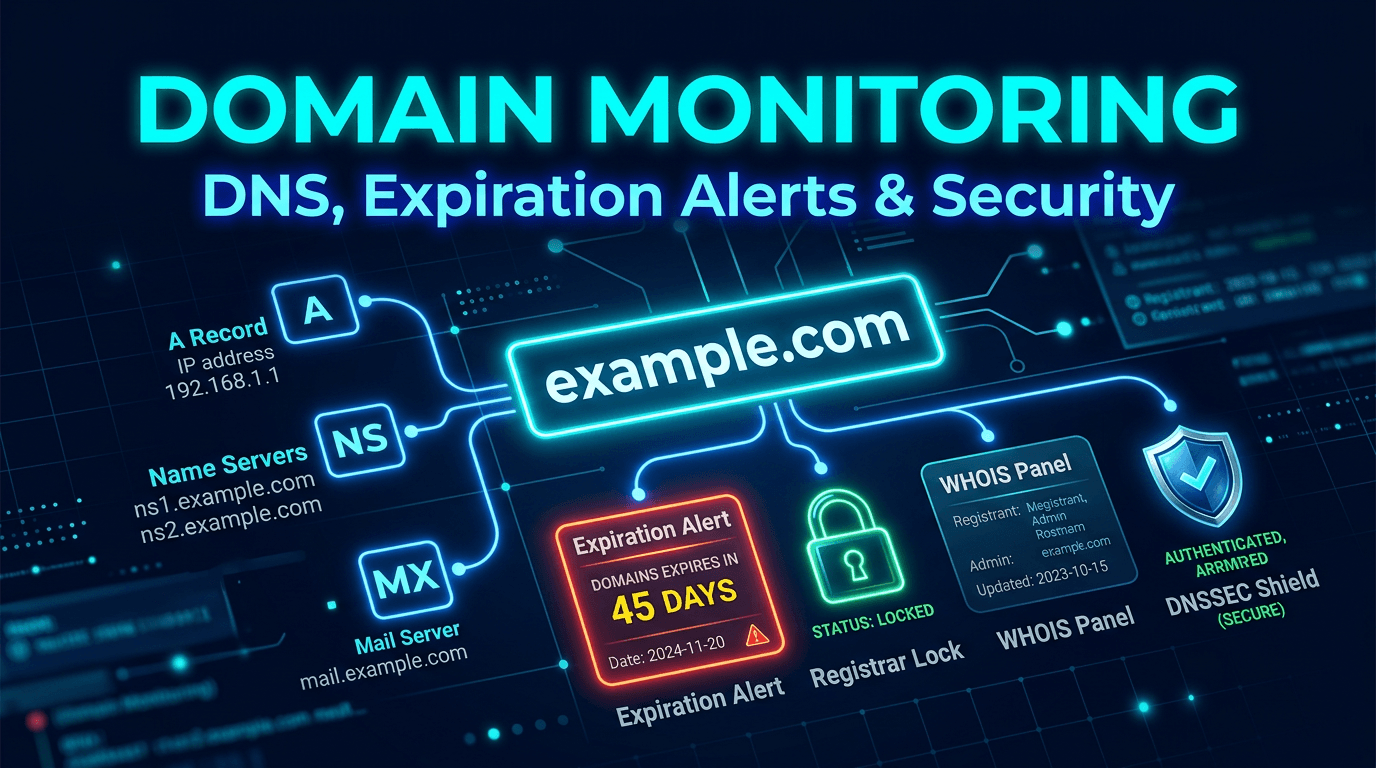
DNS monitoring is often framed as a technical infrastructure task, but in 2026 its impact reaches much further. DNS health affects whether search engines can crawl your pages, whether customers can reach your website, whether your email gets delivered, and whether attackers can quietly manipulate your domain footprint. If DNS breaks, even perfect application infrastructure becomes irrelevant because users and bots cannot reliably find it.
That is why DNS monitoring should be understood as both a growth protection system and a security control. It protects rankings, traffic continuity, brand trust, and communications at the same time. This guide explains how DNS monitoring supports SEO and security together and which practices matter most if you want fewer invisible failures and faster incident response.
Why DNS Matters for SEO
Search engines depend on stable resolution to crawl and index pages. If a domain or subdomain does not resolve correctly, crawlers cannot fetch content consistently. Even partial resolution problems can create crawl inefficiency, delayed indexing, and lost visibility on important templates. This is especially risky during site migrations, content launches, or campaign periods where crawl timing matters.
SEO teams sometimes focus heavily on content, metadata, and page speed while treating DNS as someone else's layer. But DNS instability can erase the benefits of all that work. High-value landing pages, blog templates, localized subdomains, and product categories all depend on reliable domain resolution. Monitoring DNS means protecting the path search engines use to reach your site in the first place.
Why DNS Matters for Security
DNS is also a high-value target for attackers and a sensitive area for operational mistakes. If nameservers change unexpectedly, if critical records drift, or if registrar-related trust signals shift without approval, the brand can become exposed to hijack risk, phishing abuse, or traffic redirection. Because DNS is foundational, even a small unauthorized change can have large consequences.
Security teams therefore benefit from DNS monitoring just as much as reliability teams do. It turns hidden changes into visible events and makes it easier to distinguish approved operations from suspicious behavior. In many organizations, DNS monitoring is one of the earliest warning systems available for domain-level compromise or configuration drift.
Record Type Visibility Is Essential
A mature DNS monitoring setup does not only watch A records. It should track the full set of records that matter operationally: A, AAAA, CNAME, MX, TXT, NS, and sometimes SRV or service-specific entries. Each one plays a different role and each one can cause a different category of incident.
For SEO, A, AAAA, CNAME, and redirect-related records affect reachability. For communications, MX, SPF, DKIM, and DMARC-related TXT entries affect email trust and deliverability. For security, NS and registrar-linked trust signals are especially important because they can indicate shifts in control. A monitoring system that ignores these layers will miss the types of changes that often matter most.
Nameserver Alerts Deserve Special Priority
Unexpected nameserver changes should rarely be treated as normal. They represent a potential shift in control or routing authority and can cause broad resolution failures even before teams fully understand what happened. That is why NS monitoring belongs in the highest-priority category for most organizations.
If a nameserver change is planned, it should be documented and tied to a maintenance process. If it is not planned, it deserves fast human review. This simple discipline dramatically improves the chance of catching dangerous domain events before customers or search engines experience sustained impact.
DNS Monitoring Helps Protect Email Deliverability
The connection between DNS and email is frequently underestimated. MX records control where mail goes. SPF, DKIM, and DMARC influence whether messages are trusted. If these records change unexpectedly, the result may not be an obvious website outage but a silent communications problem that damages customer experience and internal operations.
Password resets, invoices, support replies, outreach, product notifications, and marketing workflows all rely on healthy email DNS. Monitoring those records gives teams an early-warning layer that protects more than website traffic. It protects communication continuity, which is often just as important during incidents.
Multi-Region DNS Visibility Matters
DNS answers can vary by resolver, region, cache state, and propagation timing. A change that looks healthy in one location may still be stale or broken elsewhere. That makes single-perspective monitoring weak, especially during migrations, provider changes, and urgent incident response.
Multi-region DNS monitoring gives better context immediately. It helps teams see whether a problem is global, localized, or propagation-related. That kind of visibility is valuable for both security and SEO because a partial DNS problem can still disrupt crawler access or customer traffic in major markets without triggering an obvious universal outage.
DNS Drift Is a Real Operational Risk
Not every DNS problem comes from a dramatic incident. Many come from slow drift. A record changes during a vendor onboarding. A TXT entry is left behind after a one-time verification. A legacy CNAME still points to a retired service. An old subdomain still exists but nobody remembers why. Over time, the gap between intended configuration and actual DNS state grows.
DNS monitoring helps by creating a historical record of what changed and when. That allows teams to compare the live state to the expected state and find drift before it creates a public problem. Drift detection is one of the highest-value long-term outcomes of monitoring because it catches preventable issues while they are still quiet.
SEO Teams Should Monitor the Domains That Drive Traffic
The most effective SEO organizations do not leave DNS visibility entirely to infrastructure teams. They identify which domains and subdomains drive the most organic value and ensure those assets receive priority monitoring. This includes primary domains, international properties, docs sites, blog subdomains, and campaign landing environments that matter for search performance.
This cross-functional approach works because DNS failures are not purely technical when they affect rankings and crawl access. If a market-specific domain becomes unstable or a redirect property fails during a migration, the growth impact can be immediate. SEO-aware DNS monitoring prevents teams from learning about those issues only after traffic drops.
Security Teams Should Track Change Context, Not Just Change Events
Not every DNS change is bad. CDNs rotate infrastructure. Email vendors update recommended records. TXT entries change during verification flows. The real value of monitoring comes from understanding context. Was the change approved? Did it happen in a maintenance window? Was it expected on this domain? Did related trust signals change too?
This is why mature monitoring systems classify changes and connect them to ownership. A changed TXT record may be low priority. A nameserver change plus a registrar unlock plus a contact update may be highly suspicious. Context transforms monitoring from a noisy diff stream into a genuine security control.
Common Mistakes to Avoid
One common mistake is monitoring only expiration dates while ignoring live DNS changes. Another is watching website records but forgetting about email-related records. Teams also often assume DNS is fine if the homepage loads, even though crawlers, mail systems, or regional users may still be affected differently. A final mistake is failing to maintain ownership, which means alerts arrive but nobody knows who should act first.
Another subtle error is treating DNS change logs as historical trivia instead of operational evidence. The change history is often one of the most useful tools for explaining why an outage or trust issue began when it did.
What to Look for in a DNS Monitoring Platform
The best DNS monitoring platforms support multi-record tracking, nameserver alerts, historical diff visibility, multi-region resolution checks, and strong alert routing. It is even more useful when DNS visibility can sit beside uptime, SSL, and broader domain monitoring so teams can correlate symptoms quickly.
A useful platform should help answer practical questions: what changed, when did it change, how serious is it, is it expected, and which business capability might be affected? If those answers are easy to find, incident response becomes much faster.
DNS monitoring matters in 2026 because DNS is where reliability, growth, and security intersect. It supports crawl access for SEO, continuity for email, trust for users, and visibility for security teams. A single unnoticed change can disrupt all of them at once.
The smartest organizations now treat DNS monitoring as a strategic protection layer, not a background admin task. When implemented with ownership, multi-region visibility, and meaningful change context, it becomes one of the most effective ways to protect both rankings and domain trust.